

Leeghwater Ateliers 26 Opendag 26 Mei 2022
- Leeghwater Ateliers 26 Opendag 26 Mei 2022
- May 26, 2022 until May 27, 2022
- Online exhibition
Works on display
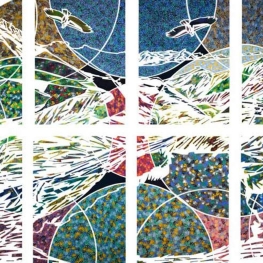
Tourmalet
2022The Col du Tourmalet is a mountain pass in the Pyrenees that owes its name to a flood of the river Gave in the eighteenth century. Because of this flood, traffic was forced to take this pass. The name 'Tourmalet' means something like 'bad detour'. Long before the mountain became known by the Tour de France, it was mainly climbed by pilgrims or by shepherds with their flock. In the year 1910, the 2115 meter high mountain was included for the first time in the route of the Tour de France. The French cyclist Octave Lapize was the first cyclist to reach the top and since then the ascent of the Tourmalet has been part of the Tour almost every year, often as part of the so-called 'Queen's Stage', the toughest stage in the Tour. We also chose this 'bad detour', and not for the first time, because we are always impressed by this special landscape.
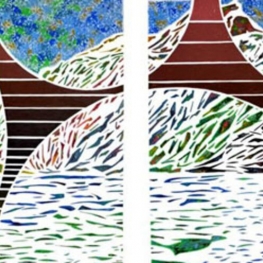
Jøkelfjord 2021
2021Jøkelfjord is a fjord in northern Norway. This is where the Øksfjordjøkelen debouches, the 8th largest glacier on the Norwegian mainland and the only one of which the ice tongue reaches into the sea. The glacier covers an area of approximately 43 km² and the highest point is 1,204 m above sea level. This is also the highest point of the Norwegian province of Finnmark.
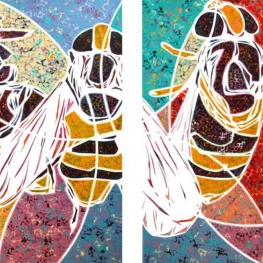
The Hornet Mimic Hoverfly
2022One day in the summer he stopped by. This Hornet Mimic Hoverfly has a yellow abdomen with thin black transverse stripes, a brown-orange shiny thorax and a yellow head. It resembles a bee or bumblebee, but it is a hoverfly. Until recently the insect was rare here, but with the warmer summers it is seen more and more often. It has a preference for an urban environment. The eggs are laid at the bottom of a wasp's nest and the larvae hibernate there when the wasps leave the nest, to pupate the following summer into a new generation of hoverflies. It grows larger (2.5 cm!) than most other species of hoverflies and, like all hoverflies, it lives on nectar and pollen. It cannot sting, but by size and colors resembles the Hornet, one of the most venomous insects. This advantageous resemblance to another species is called mimicry. Other hoverflies look more like small wasps because of their black-yellow stripes or bumblebees because of dense hair, but they all miss the slim ‘wasp-waist’ and fly with skittish movements.
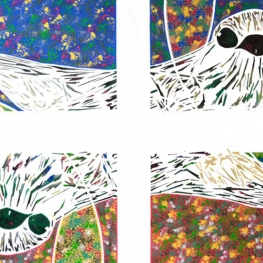
Garden-warbler
2021Shortly after we hung an insect-hotel on our garden wall, we discovered that a garden- warbler had chosen to build a nest of moss and grass on top of it. The garden- warbler is a song-bird of about 14 cm in size (incl. tail feathers), which usually makes a bowl-shaped, well-hidden nest in dense vegetation. It has a rather inconspicuous appearance: a brownish-gray top and a light yellow-brown underside, a round head with a pointed brown beak and gray-brown legs. The food consists of insects, berries and seeds. The garden-warbler breeds from early May to July. One brood per year, with, in our case 4 eggs of which 2 hatched. Breeding time is only 11-12 days. Apparently both parents sit on the eggs, but we didn’t observe that: the male only occasionally brought some food. After hatching, the young were in the nest for 10 days before they flew out, from that moment on we never saw them again. Between July and October, the garden-warbler migrates via France, Spain and Portugal to Africa, where it hibernates south of the Sahara. The crossing to Africa takes place largely via the Strait of Gibraltar.
Location
Leeghwater ateliers 26 OpendagLeeghwaterstraat 26
1462JE Middenbeemster
Nederland
06 10915019
www.ruudstreefkerk.com
- Do
- 10.00 tot 17.00 uur
- Vr
- 15.00 tot 17.30 uur