
Great Britain
this file contains works of art which are based on impressions of my journey through England and Scotland, including a.o. the Scottish Highlands, the coast and English and Scottish gardens.
dated 2020 until 2023
(click on an image to enlarge an artwork)
stuur een bericht
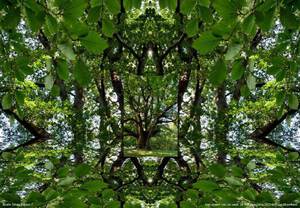
Boom Shute Barton 7
2023Looking for old trees in England, we ended up on a National Trust Estate near Colyton. It’s one of the most important mansions that survived from the Middle Ages. It was built around 1380 and expanded at the end of the 16th century (and partially demolished in 1785). Nevertheless, much of the original 14th-century house was preserved. For example, the Will of William Bonville, the original builder, dating from 1407, states: 'ma salle' (my hall), 'ma chambre' (my room), 'panetry' (the pantry for bread preparation), 'botellie' (for storage of wine), 'cusyne' (kitchen) and 'pestrine' (the pâtisserie). In 'ma salle', the main hall, the huge fireplace survived, which covers almost the entire width of the room and is 10 feet deep. This fireplace is said to be the largest existing Medieval fireplace in Britain, with a span of 24 feet. But we came for the centuries-old trees that grow here.
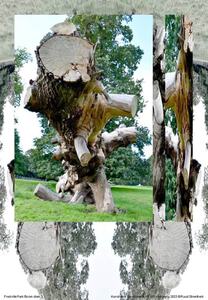
Fredville Park Trunk 3
2023We were in search of the 'Majesty Oak', the largest oak in the UK, on the Fredville Park Estate in Nonington, when we spotted this trunk of a Sweet Chestnut. Sweet chestnuts are recognizable by the long and coarsely-serrated, lancet-shaped leaves, glossy dark green on the upper side and slightly lighter on the bottom side. Beetles, flies and bees are the pollinators of the flowers. In autumn, the ripe fruits of the sweet chestnut fall from the tree. The nuts are embedded in a vicious prickly shell, which is formed by the bracts. Sweet chestnuts can be cooked, peeled and eaten. This is in contrast to the nuts of the poisonous Horse Chestnut (Aesculus hippocastanum), belonging to a completely different family. Not only humans, but as well wild boars, squirrels, jays, crows and mice eat sweet chestnuts. They ensure the scattering of chestnut trees in the wild.
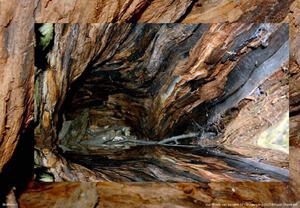
Inside 1
2023In Fredville Park in Nonington, in the county of Kent in England, we are looking for the Fredville Oak, which by connoisseurs is considered to be the most impressive oak in Great Britain. It is one of the thickest oaks of the United Kingdom as well as a non-headed tree (a so-called 'maiden oak') with a rather long trunk and a large top. In the early twentieth century a huge branch broken off at 3 to 4 meters height on the South side of the trunk. Since then a huge hole yawns on this side, enabling one to cast a glance into the completely hollow trunk, as if it were a dark cave.
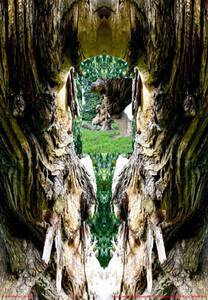
Fredville Park Stump 7
2022The roots of this stump of one of the many impressive Sweet Chestnut trees in Fredville Park in Nonington, near Canterbury in Kent, give us a glimpse into a fairy tale world. One gets lost between the roots and discovers all kinds of things over and over again. But in fact we came to this Public Estate for the 'Majesty', the ancient Fredville Oak. The opinions about the age of this oak differ widely. There are people claiming that it is at least a 1000 years old. But the well-known English dendrologue Alan Mitchell estimated it in 1990 about 450 years old, yet still a very respectable age. ...
Cowdray Park 5
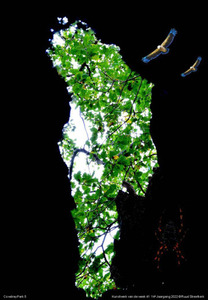
2022We're here at the Cowdray Park Estate, where a probably 800- to 1000-year old oak grows: The Queen Elizabeth Oak. The estate is owned by the Viscount of Cowdray whose family has owned it since 1908. In addition to more traditional activities such as agriculture and forestry, it has a golf course, it is home to the Cowdray Park Polo Club, and the count organizes clay pigeon shooting and business-outings on his property. We were searching for old trees in this part of England and The Queen Elizabeth Oak is one of the many Ancient Trees that can be found here.
Wier Scourie 1
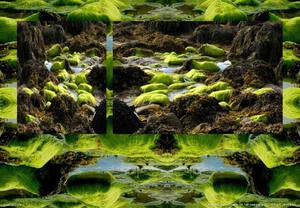
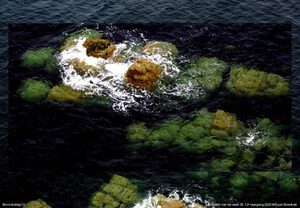
2022Scourie is located in the Scottish Highlands, opposite the island of Handa. The island (in Gaelic: Eilean Shannda) is located off the west coast of Scotland and is 3 km² in size. The Gaelic name comes from the Norwegian word Sandey, which means sandy island. It consists of Old Red Sandstone and is surrounded by cliffs. In the north is a hill with a height of 123 meters. On the north and west coast are high cliffs up to 100 meters and in the south and east are beaches. In prehistoric times, Handa was used as a cemetery. There are still remains of a chapel called Tràigh an Teampaill which means Temple Beach. At its culminating-point the island had 65 inhabitants and a parliament, the oldest widow was the Queen of the island. But the potato famine of 1846 forced the inhabitants to emigrate. Today the island is part of the Scourie Estate, owned by Dr. Jean Balfour and J.C. Balfour and managed by the Scottish Wildlife Trust. At low tide, the boulders on the coast are dry and overgrown with seaweed.
Sarracenia 2
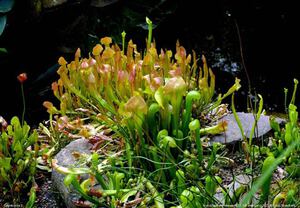
2022In the Inverewe Gardens on the West Coast of Scotland we spot these carnivorous plants, the Sarracenia, or Trumpet Pitcher, which is indigenous on the eastern seaboard of the US and southeastern Canada, the Great Lakes area and Texas. Sarracenia’s leaves have evolved into a funnel or pitcher shape in order to trap insects. It attracts its insect prey with secretions from extrafloral nectaries on the lip of the pitcher leaves, in combination with the leaves' bright color and scent. Slippery footing at the pitcher's rim, causes insects to fall inside, where they die and are digested by the plant with proteases and other enzymes
Tree trunk Rendlesham 3
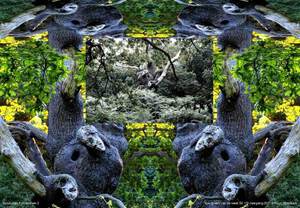
2021In this forest in Suffolk, England, a strange tree-trunk struck me, not knowing that a special incident took place here. The Rendlesham Forest incident was a reported sighting from the nearby RAF Woodbridge Military Base, which was used by the US Air Force at the time. On December 26 1980, around 3:00 a.m., a military security patrol saw unexplained lights descending into this nearby forest. The five soldiers initially thought it was a crashed plane, but when they entered the forest to examine it, it turned out to be a glowing craft with a metallic appearance and colored lights. When they tried to approach the object, it seemed to move through the trees. They followed it for almost an hour through the forest and across a field, until it took off at phenomenal speed. Animals on a nearby farm made a hell of a noise. Their Colonel Charles Halt made an official report of it. In addition to a flashing light in the east, according to Halt's memo, three star-like lights were seen in the sky, the brightest of which seemed to emit a stream of light from time to time. This observation coincided with the appearance of a bright fireball over southern England, attributed by astronomers to a piece of falling debris from space. The story was questioned by authorities, leading to allegations of a cover-up, as part of a larger pattern of information-suppression related to UFO’s. In any case, I thought this was a strangely shaped dead tree.
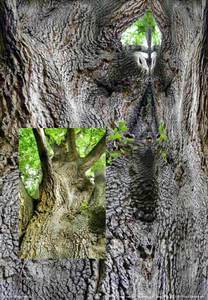
Boom Shute Barton 5
2021Looking for old trees in England, we ended up on a National Trust Estate near Colyton. It’s one of the most important mansions that survived from the Middle Ages. It was built around 1380 and expanded at the end of the 16th century (and partially demolished in 1785). Nevertheless, much of the original 14th-century house was preserved. For example, the Will of William Bonville, the original builder, dating from 1407, states: 'ma salle' (my hall), 'ma chambre' (my room), 'panetry' (the pantry for bread preparation), 'botellie' (for storage of wine), 'cusyne' (kitchen) and 'pestrine' (the pâtisserie). In 'ma salle', the main hall, the huge fireplace survived, which covers almost the entire width of the room and is 10 feet deep. This fireplace is said to be the largest existing Medieval fireplace in Britain, with a span of 24 feet. But we came for the centuries-old trees that grow here.
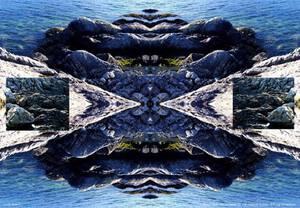
Loch Awe 3
2021Here in Loch Awe, the longest (41 km) and third largest freshwater lake in Scotland, we see a rock formation with its worn-off shape shining in the blue water. Trout and salmon pass through this lake into the Awe River. In the 1950s, a hydroelectric power station was built in the lake, equipped with a special slow-moving turbine, to let young salmon pass, without harming them. In addition, water is pumped up to a storage reservoir in the hills above Loch Awe, from which water is released at peak hours, to operate four pump generators, located inside the mountain. On some islands in the lake are castle ruins and on a headland on the north side lies one of the most photographed castles in Scotland: Kilchurn Castle.
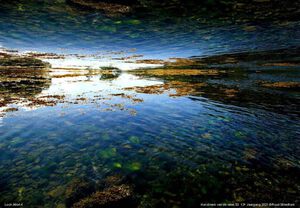
Loch Ailort 4
2021Loch Ailort is a sea arm with a town of the same name at the end, on the west coast of Scotland. This coastline is very sparsely populated, only occasionally one comes across a farm or hunting lodge. Algae grow on the bottom of Loch Ailort, which means that this water is part of the so-called 'photic zone'. That zone can range from just a few inches deep in muddy water to around 200 m depth in open ocean water. But we are here on the edge of the European continent. Just a skirt of the 'continental shelf', and then comes the actual ocean floor: the 'abyssal plain', with deep oceanic trenches. In these deepest parts of the ocean, only specialized organisms, who are able to withstand the high pressure, can survive.
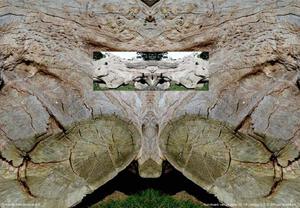
Fredville Park Trunk 6
2021We were in search of the 'Majesty Oak', the largest oak in the UK, on the Fredville Park Estate in Nonington, when we spotted this trunk of a Sweet Chestnut. Sweet chestnuts are recognizable by the long and coarsely-serrated, lancet-shaped leaves, glossy dark green on the upper side and slightly lighter on the bottom side. Beetles, flies and bees are the pollinators of the flowers. In autumn, the ripe fruits of the sweet chestnut fall from the tree. The nuts are embedded in a vicious prickly shell, which is formed by the bracts. Sweet chestnuts can be cooked, peeled and eaten. This is in contrast to the nuts of the poisonous Horse Chestnut (Aesculus hippocastanum), belonging to a completely different family. Not only humans, but as well wild boars, squirrels, jays, crows and mice eat sweet chestnuts. They ensure the scattering of chestnut trees in the wild.
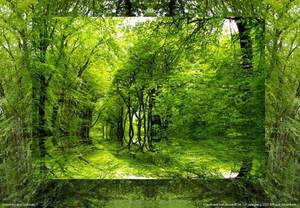
Dumfries and Galloway 1
2021We are here in the Southern Highlands of Scotland. This region has a number of south-flowing rivers, dividing the landscape into a series of hills. These divisions created historical counties, most of which exist for more than a thousand years and which in themselves are often logical geographical entities. In Scotland, they were known as Sheriffdoms: a group of parishes over which the sheriff had jurisdiction, when the indigenous Celtic forms of government were replaced by Norman feudal structures.
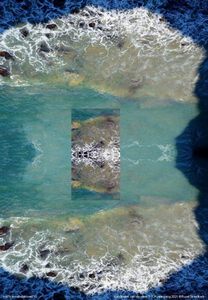
Hell's Mouth Cornwall 10
2021This path along the South West coast of Cornwall runs from lighthouse to lighthouse, and originated as a route for the Coast Guard, to patrol on smugglers. They had to be able to look into every bay and inlet, and as a result the path runs close to the coast and offers beautiful views, but it is rarely the most direct connection between two points. The South West Coast Path is no longer used by the Coast Guard, but nowadays it is a pleasant route for recreational walkers. It is the longest signposted long-distance path in England.
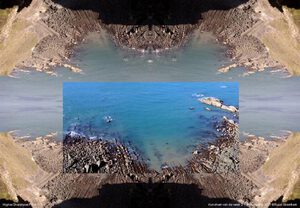
Higher Sharpnose Point 1
2021This is the view from the narrow path that runs over the cliffs of Higher Sharpnose Point on the west coast of Cornwall (GB). This spit of land is mainly known by Hawker's Hut, a historic hut that was built by Robert Stephen Hawker (1803-1875), an eccentric preacher, poet and antiquarian. He built the hut of drift-wood and wood from shipwrecks, partly in the hill and covered it with soil and a grass-roof. Parson Hawker spent many hours there writing poems, receiving famous contemporaries and smoking opium.... It is currently the smallest property owned by the National Trust. At the foot of these cliffs innumerable small rocky spits of land stretch out in the Atlantic Ocean, they are referred to as 'point', 'nose' or 'head'.
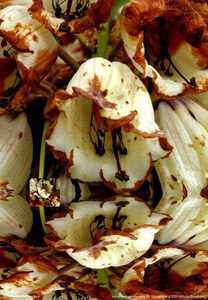
Flower Inverewe Garden 1
2020This is an almost blown flower of a Rhododendron in the Inverewe Garden, a 20-acre botanical garden on the West-coast of the Scottish Highlands. The garden was laid out in 1862 by Osgood Mackenzie on a barren part of the 850-acre estate that his mother bought for him. Initially, the challenges were to provide for a wind-break from the sea and for a more fertile soil. To this end, he planted a mixture of large trees and shrubs, such as Corsican pine, Douglas fir and Rhododendrons. After that, until his death in 1922, he exerted himself to grow as many exotic plants as possible (2500!) that could thrive in this climate.
Bornesketaig 13
2020We are here on the west side of the Scottish Highlands. To be precise, on the Trotternish Peninsula on the north coast of the Isle of Skye. Here is also the Skye Museum of Island Life, a nice open-air museum with a particular attention for the so- called Crofters. Crofting is a traditional social system in Scotland, characterized by small-scale food production. In the Highlands and on the Scottish Islands, 30% and 65% of the population still live as crofters on small farms where agriculture takes place and where roughage and vegetables are grown. In addition, crofters form common working communities, called townships. Each township manages hilly terrain of lesser quality as a common meadow for cows and sheep. But it‘s a meagre existence: most crofters are forced to undertake a number of other activities besides farming to make a living.