
Sweden
Sweden A country with many lakes and ‘forever singing’ forests, an impressive coastline with prehistoric rock carvings and up north the solitude of the tundra.
dated 2018 until 2023
(click on an image to enlarge an artwork)
stuur een bericht
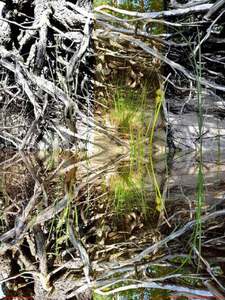
Blattnicksele Boomwortels 5
2023This summer we visited the banks of the Vindel River near the village of Blattnicksele in Lapland for the second time. Due to the continuing drought, the washed-out roots of the trees on the banks of the river were completely dry this time, whereas in 2015 the roots still stood in the water. The Vindel is one of Europe's few undisturbed and unpolluted rivers with an enormous diversity of fish. When the large-scale plans for energy generation by means of this river in the 1960’s would have been carried out, a nearby village would have disappeared in a 38 meters deep reservoir. But thanks to a huge wave of protests, the project was finally canceled. Nowadays the Vindel river is even appointed as one of the four national rivers of Sweden.
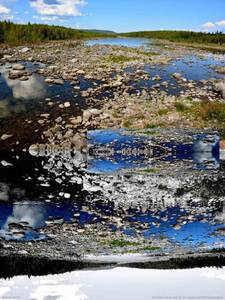
Blattnicksele 18
2023Blattnicksele 18 The Vindel River flows past the campsite in the hamlet of Blattnicksele in the municipality of Sorsele in Lapland, and is surrounded by pine forest. Europe's largest nature reserve is to be found here: the Vindel Mountains Nature Reserve. This river, amongst others, has its source in this vast region. It is one of Europe's few undisturbed and unpolluted rivers, with a dozen impressive rapids. Few rivers in Sweden offer such a great abundance of fish species, such as grayling, sea trout, and arctic whitefish, a paradise for fishermen. I met an angler from the Netherlands with a Lapse friend, who knew all the good fishing spots. He filled the (large) freezer in his car with the fish he caught, and ate of it back home for as long as a year.
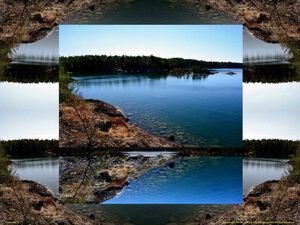
Hjälmaren 6
2023Hjälmaren is Sweden's fourth largest lake. It lies West of Stockholm and is connected to the city by a channel. The lake is 63 kilometres long, up to 20 km wide and has an average depth of 6 m (with a maximum of 22 m) and an area of 483 km2. On the Western bank of the lake lies the city of Örebro. The lake has become an iconic spot in Sweden by the music festivals that are organized on the banks. Among others ‘The Smashing Pumpkins’, ‘Sonic Youth’ and ‘Pearl Jam’ performed here. Like many places in Sweden, Hjälmaren is also known as a product of Ikea, in this case storage racks. On the internet I find this description: the Hjälmaren storage series is all about simple ways to get what you want, from towels to your hairbrush. There is even a cart with boxes to organize for your bits and pieces and to move them to where you need them!
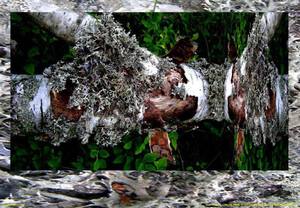
Birch bark 4
2023The outer layer the bark of a birch is constantly renewing itself and sometimes comes off into thin strips. These strips have a great endurance towards decay because the bark contains Betulin. This enables to make all kinds of sustainable products from it. The Sami and North American Indians made canoes, shoes, leg-coverings and even coats from it. In both America and Scandinavia the bark was also used as a roofing material because it is light, water-repellent and very durable. From narrow, braided bars, also bags and baskets were made. These strips of thin bark are extremely suitable for use as a fire starter, even when wet. The bark was also used in prehistoric times, some 48,000 years ago, to produce birch-pitch, a type of glue. In Northern Europe and Siberia, the birch was worshipped as a sacred tree. It is the tree of wisdom, light and new spring and of renewal in general. The Germans attributed magical and medicinal properties to its leaves, twigs and sap and believed that birches formed the earthly dwelling-place of the goddess Freya. Among the Celts, the birch is dedicated to Brigit, goddess of poetry, divination and medicine.
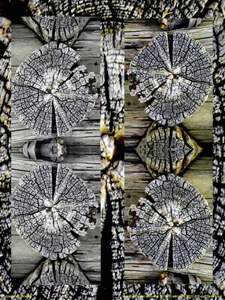
Siljansfors, Mora 6
2022Historically, the construction of log cabins has its roots in Scandinavia and Eastern Europe. The basic form of log construction was later imported to America. The first tree trunk constructions were probably built in the Bronze Age (15th century BC). In the Middle Ages, log cabins were considered movable property.The buildings were simply dismantled, transported to a new location and reassembled, for with the right tools and the availability of large straight logs (pine and spruce), a family can build a log cabin within a few days and in any weather or season. They are usually built without the use of nails and owe their stability to simple stacking, with only a few connections of wood plugs for reinforcement. Many ancient towns in northern Scandinavia consisted exclusively of log cabins. Today, the construction of modern log cabins as recreational homes is a fully developed industry in Finland and Sweden.
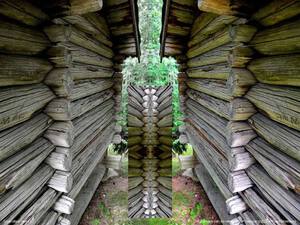
Siljansfors, Mora 5
2022This log cabin is located in the open air Forest museum Siljansfors-Mora, where the story of the historic Swedish timber industry is told. About the logging industry itself, to charcoal-fired furnaces and forges for the extraction of iron ore. Scattered around the site are a number of old log cabins that were part of the industrial process and for housing of the workers. Apart from a 7000-year-old tree trunk, there are also permanent exhibitions of all kinds of tools for sawing, ploughing and transport of the felled wood. Although a fairly complete image is given of the industry that provided livelihood for the population in this part of the country for a long time, I personally didn’t spot that much interesting objects, but that is a matter of taste.....
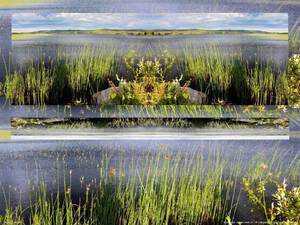
Ånge, Sweden 5
2022We go for an evening stroll from the farm-campsite in Ånge. The owner, an old farmer, created a beautiful ‘sculpture’ garden behind the campsite: between the plants and paths he set up funny objects made of old utensils. A beautiful sunset sheds its light on the river Ljungan which is very wide here. The next morning we wake up in an oasis of peace by the whistling of early birds.
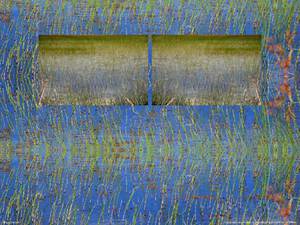
Ånge, Sweden 1
2022After a hot day we arrive at a farm-campsite near Ånge. Ånge is situated on the river Ljungan in Västernorrlands County in Sweden. The river originates in the Scandinavian Highlands, just north of the Helagsfjället mountain range, and flows east for 399 kilometers before it debouches into the Gulf of Bothnia. The water did rise so high that some low parts of the campsite are flooded, the stems of tenuous horsetail-plants are just visible.
Hjälmaren 5
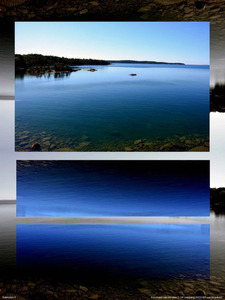
2022Lake Hjälmar is the fourth largest lake in Sweden. It is 58 km long and 18 km wide and in general shallow (around 6 meters). The city of Örebro lies adjacent to the lake and it contains countless islands, the largest of which is Vinön (the 'wine island'). Major music festivals are held on the banks. The name Hjälmaren may remind us of a wardrobe by Ikea, and that fits: their furniture is named after cities or landscapes in Sweden.
Ångermanälven 7
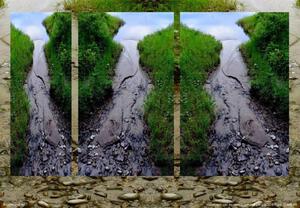
2022A small stream flows into the Ångermanälven. The Ångermanälven is a Swedish river that takes rise in Lapland, flows right through the middle of the province of Norrland and debouches into the Gulf of Bothnia. The name Ångermann or Angermann is derived from an old Norse word meaning 'deep fjord'. 'Anger' is therefore more common in place-names along the coast of Norrland.
Tree Hjo 1
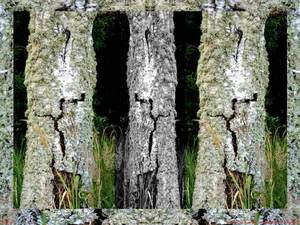
2021The small town of Hjo with its wooden houses is located on Lake Vättern near Göteborg in Sweden. Lake Vättern is Sweden’s second largest lake. The deepest point is 128 m. The water supply above ground is smaller than its discharge, but the difference is apparently supplemented by subterranean water flows. Locally the shore may be very steep and offering a lot of natural beauty. I noticed some dead, mossy birch trees at the rim of the beach, giving the impression of being carved in the past.
Birch bark 2
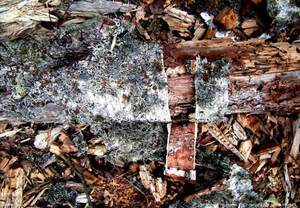
2021The outer layer the bark of a birch is constantly renewing itself and sometimes comes off into thin strips. These strips have a great endurance towards decay because the bark contains Betulin. This enables to make all kinds of sustainable products from it. The Sami and North American Indians made canoes, shoes, leg-coverings and even coats from it. In both America and Scandinavia the bark was also used as a roofing material because it is light, water-repellent and very durable. From narrow, braided bars, also bags and baskets were made. These strips of thin bark are extremely suitable for use as a fire starter, even when wet. The bark was also used in prehistoric times, some 48,000 years ago, to produce birch-pitch, a type of glue. In Northern Europe and Siberia, the birch was worshipped as a sacred tree. It is the tree of wisdom, light and new spring and of renewal in general. The Germans attributed magical and medicinal properties to its leaves, twigs and sap and believed that birches formed the earthly dwelling-place of the goddess Freya. Among the Celts, the birch is dedicated to Brigit, goddess of poetry, divination and medicine.
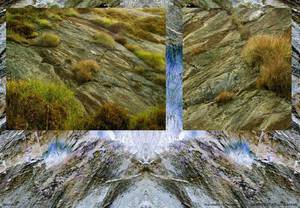
Stocken 6
2021We are here on the skerry-coast of Bohuslän, a coastal region in Sweden between Göteborg and the Norwegian border. Skerries are small rocky islands, modeled by the glaciers during the ice ages, lying in coastal areas with shallow and often brackish water. After the melting of the ice-cap, these islets rose above the surface of the water. The influence of both ice and water explains their polished, rounded shape. Skerries are found here, i.e. along the Skagerrak, but also in the Baltic Sea and the Botnian Gulf in Sweden and Finland, as well as along almost the entire coastline.of Norway. In Russia lie the relatively unknown Minina skerries in the Kara Sea, a part of the Arctic Ocean.
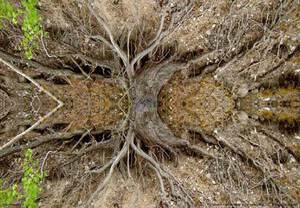
Tree roots 4
2021The root, the underground part of a plant or tree, absorbs water and dissolved nutrients from the soil. In trees, the roots become thick and woody. The tops of the roots have growing-points, growing usually downwards under the influence of gravity. This is called positive geotropy. As the main root branches, lateral roots are formed, and further branching creates a root-system. On the root are radical hairs that take care of the actual absorption of water and mineral nutrients. In the immediate vicinity of the root hairs (not further away than 1.5 mm) an increased biological activity takes place. This zone is called the rhizosphere. The root hairs are constantly replaced, they only have a limited life span and usually live no longer than3 days.
Blattnicksele Bank 8
2019The water is high in the Vindel River in the South of Swedish Lapland. But looking at the tree roots, that almost seem like a mangrove forest, this water level isn’t even extremely high. The Vindel River flows past the hamlet of Blattnicksele and is surrounded by mainly coniferous forest. Here you will find Europe's largest nature reserve: the Vindel Mountains Nature Reserve. The Vindel river, amongst others, has its source in this vast region and is one of Europe's few undisturbed and unpolluted rivers, with a dozen impressive rapids and a great variety of fish species, such as sea trout, grayling and Arctic whitefish, which makes it a fisherman's paradise. I met an angler from the Netherlands, who filled the large freezer in his car with the fish he caught here, and ate of it back home for as long as a year.
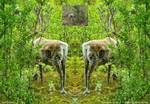
Reindeer Sweden 1
2019In the verges of the roads in Sweden, one meets them regularly: reindeers in small family groups of two to eight animals. They are not very shy, but for safety's sake they prefer to withdraw among the trees. Reindeer (Rangifer Tarandus) are the large grazers of the taiga and tundra. They live in herds and eat mostly reindeer moss, a lichen in which algae and a fungus cooperate symbiotically. Even in winter, when the tundra is covered with snow and ice, they are able to remove this with their hoofs in order to reach their frozen meal. Their main enemy is the wolf, who grabs the weaker animals. For centuries it was used by man for its fur, meat, milk and as a draught-animal. Originally reindeer were common in all the tundra’s around the North-Pole, but in the southern parts of these regions the animal disappeared. In northern Scandinavia only a few Sami families still herd reindeer on a large-scale and in a modern manner, for instance with helicopters to round them up in the fall.
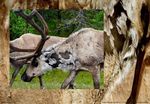
Reindeer Sweden 10
2019A few years ago we came across many reindeer along the roads through the Arctic, but recently I encountered an alarming message: Because of drought and forest fires in northern Scandinavia, the habitat of reindeer reduced. The Sami, the inhabitants of Lapland, are the only ones who are allowed to herd the animals, so this also forms a threat for their culture. According to experts, it would take 30 years for the region to recover from the extremely hot summers in recent years (which I do not think is a very likely scenario, given the global warming...). Apart from hot summers, the warm winters are also a problem. Because it rains more often, a layer of ice is created on top of the snow layer, which makes grazing seriously difficult for the animals. Without help, a large number of animals would die this winter and young animals might be too weakened to follow the annual migration. The Sami asked the Swedish government to regulate food supplies, of which a major shortage is threatening, for the 250,000 reindeer, and fortunately the Swedish government will take measures to protect the reindeer in the long term.
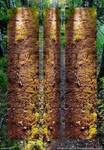
Twilight 2
2019Twilight is the period of reduced light between day and night, around sunrise and sunset. In this time of year it is twilight as well for the reindeer in the Arctic. But I'm afraid it's going to be 'Twilight' for the earth and for all of us.....or would we still have a chance to turn the tide??
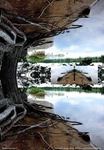
Blattnicksele shore 2
2018This summer we visited the banks of the Vindel River near the village of Blattnicksele in Lapland for the second time. Due to the continuing drought, the washed-out roots of the trees on the banks of the river were completely dry this time, whereas in 2015 the roots still stood in the water. The Vindel is one of Europe's few undisturbed and unpolluted rivers with an enormous diversity of fish. When the large-scale plans for energy generation by means of this river in the 1960’s would have been carried out, a nearby village would have disappeared in a 38 meters deep reservoir. But thanks to a huge wave of protests, the project was finally canceled. Nowadays the Vindel river is even appointed as one of the four national rivers of Sweden.
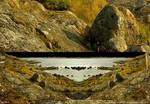
Stocken 10
2018This is a part of the rocky coast on the island of Orust in the southwest of Sweden. Orust is located on the shore of the Skagerrak, the strait between Denmark and Sweden, in the latitude of the northern tip of Denmark. The quiet and rural island is connected to the mainland by bridges and has small villages and fishing villages along the coast.