
The Netherlands
The Netherlands Works of art that are based on impressions gained in this country, where I happen to live and work, and of which I am every time I to come back from a trip think: what is actually good.
dated 2020 until 2023
(click on an image to enlarge an artwork)
stuur een bericht
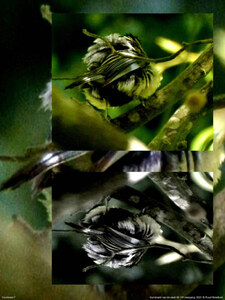
Great Tit 7
2023It is not very unique to have a number of Great Tits in our garden, after all, there is a bird peanut-butter-pot and often something for them to eat. The Great Tit is one of the most common and well-known breeding birds in the Netherlands. It has a varied vocabulary of songs and is easily recognizable by its yellow body and black head. It is common in deciduous forests, but also in villages and towns. It eagerly uses additional feeding in winter, although in severe winters large mortality can occur. It broods from the end of April, has 1 or 2 clutches per year with 8-13 white (spotted with red) eggs. Great Tits are cave-breeders but they often use nest boxes and are sometimes completely dependent on them. Neighboring nests are sometimes located 3-4 meters away. The nest is made by the female and consists of grasses, moss, animal hair, wool and feathers. The female begins to breed when 8-10 eggs have been laid. Breeding duration is 13-15 days. Chicks are fed by both parents, and the young remain on the nest for 18-21 days. After they have flown out, they are fed for another 2-3 weeks. The Great Tits in Holland are resident birds and therefore hibernate in our country. In harsh winters, Great Tits from Scandinavia and Eastern Europe come to the Netherlands in large numbers. This autumn migration of hibernators takes place between mid-September and mid-November, the spring migration takes place almost imperceptibly between mid-February and mid-April.
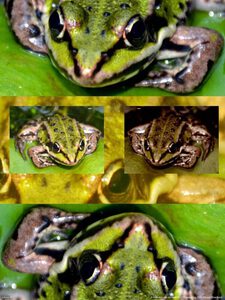
Frog 21
2023Amphibians are the transition between aquatic and terrestrial animals. Frogs lay their eggs in large lumps of frog-rit in the water. From the egg hatches a tadpole that can only survive in water: it has a long tail and gills to breathe. But in a few weeks time the tadpole changes entirely: its tail gradually disappears and four paws start to grow, the gills are replaced by lungs. The animal has become a real land animal and climbs ashore.
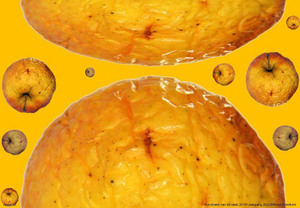
Appel 58
2023This forgotten apple travelled with us to the utmost Northern point of Norway, but wasn’t eaten en route, and so it finally returned to the fruit bowl at home. It came into being in the summer as a small fruit, it grew and ripened and its smooth and shiny skin obtained a beautiful color. But by now it’s already a bit dehydrated. What do I do with it? Will it find the way to our compost-heap, or shall I follow its development? I decide to do the latter: I will capture its decay. Slowly it dries up further and day after day I take a picture of it.
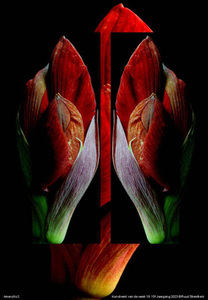
Amaryllis 2
2023The plants we call Amaryllis, actually belong to the genus Hippeastrum, a genus of bulbs from the Daffodil family. Its second name Amaryllis is used worldwide nowadays, but Hippeastrum is the correct botanical name. The plant originates from South America and has 4 to 6 flowers on a hollow stem. However, the real Amaryllis Belladonna is another plant, originating from South Africa, with 6 to 12 flowers and a solid stem. To make it more complicated, two Dutch growers moved to South Africa in 1946 to grow the South-Amarican Hippeastrum there. And up till now most cultivated forms of Hippeastrum come from the Netherlands or South Africa. Generally the Dutch bulbs produce flowers first and develop their leaves afterwards. The South African varieties develop their flower stems and leaves simultaneously. It is quite possible to winter the Amaryllis, provided it receives enough warmth and light in the summer and has a sufficiently spacious pot with nutritious soil. These ensure a good development of the bulb. If one doesn’t cut the leaves and allows the bulb a period of winter-rest, it will probably bloom again the following year.
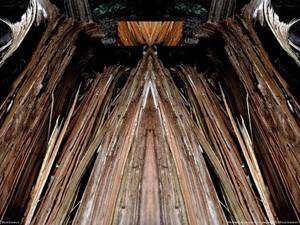
Boom Ermelo 4
2022There was a time that the Netherlands were largely covered with forests. The name Holland (holtland or woodland) refers to this. However now, forest covers not yet 11% of the surface, which results in the Netherlands being one of the least wooded countries in Europe. To see a proper forest, one would have to cross the border. It is sometimes thought that forests are a supplier of oxygen, but when the wood is rotting or burning, there is as much oxygen consumed as was issued during the life of the tree. The stored carbon (C) joins with the O2. Because we continue to pump up and burn the trees, plants and plankton from primeval times (in the form of oil or otherwise), we add the present huge amounts of CO2 to the atmosphere, causing great imbalance .
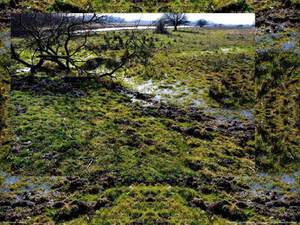
Tree stump Twiske 3
2022The recreational area Twiske was laid out from1964 until 1968 between the municipalities of Landsmeer, Oostzaan, Purmerend and Ilpendam in the Netherlands. Originally the area consisted mainly of peat meadows along the river Twiske, that flows from the North towards the river IJ. Probably the name used to be Twixt-A, the small river ‘A’ that formed the border between Landsmeer and Oostzaan. The West-Friesian village of Twisk near Hoorn was also named after such a boundary-river. For centuries peat was won around these villages on a small scale. Around 1930 land- reclamation was executed, but the reclaimed farmland turned out to be of a rather poor quality, so these plans were abandoned in the late 50’s. In the 60 's lots of sand was dug out for the construction of the Coentunnel-road, creating a more than 30 meter deep lake. Afterwards it was decided to destine the lake and its surroundings to become a recreation area. Gradually a natural balance is arising: a diverse population of birds settled here, such as the bittern, shoveller, widgeon, bearded tit, sand-martin, kingfisher, nightingale, great spotted woodpecker, kestrel, hawk and buzzard.
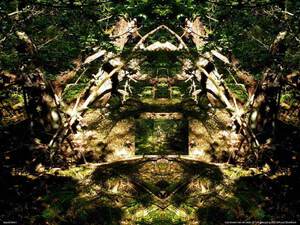
Appelscha 1
2022Light plays through the trees of the Drents-Friese Wold, near the village of Appelscha. The village was first mentioned as Apples in Medieval archives in 1247, the ending 'scha' means forest. For centuries, the settlement consisted of only a few farms, but from 1827 the village expanded enormously with the arrival of thousands of Frisian workers, who settled here for the sake peat-cutting. The social conditions among the labourers were very bad, with the result that in 1888, when peat yielded much less than coal, a large strike broke out among the peat-workers. This was the beginning of organized strikes in the Netherlands. Since 1933, the Pentecostal Field Days, an annual Anarchist festival, take place in Appelscha, From 1954 until about 1980 I used to camp here every summer with my family.
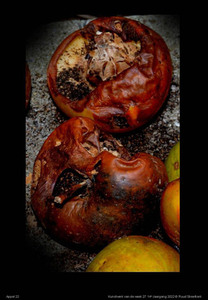
Apple 22
2022‘As the tree, so the fruit’, although the apple that fell from this tree is already beginning to decay. The fruit is eaten by birds or from the inside by insects and worms, with the final aim that the seeds are released and able to germinate, so new trees may sprout. Slowly the yellow-red glow disappears from its skin, it turns darker and darker, finally ending in black. Apples (Malus) were gathered in the wild in Europe as early as 10,000 years B.C. and cultivated in the Near East around 4,000 BC. The genes of these ancient apple varieties are scattered along the Silk Road from China. Then the apple turns up in ancient Greece and subsequently the Romans spread them across Western Europe, resulting the fact that in the19th century many cities in Europe and in the Netherlands had their own apple varieties. These breeds were different in color, size and taste.
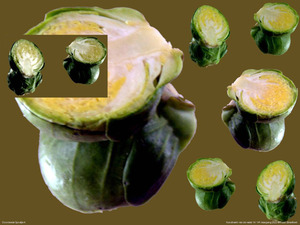
Cross-section Brussels sprout 4
2022Brussels sprouts (Brassica oleracea, variety gemmifera) are a type of cabbage whose axillary buds, better known as Brussels sprouts, are eaten. Originally, Brussels sprouts originate from the Mediterranean region, where they were cultivated for thousands of years. In the Middle Ages, the cultivation also started in Northern Europe, but when exactly is unclear. According to some this was already in the 5th century, but according to others Brussels sprouts only ended up in the vicinity of Brussels in the 13th century. The original French name is Choux de Bruxelles. In many languages, including South African (Brusselspruit), Italian (cavolini di Bruxelles), Polish (brukselka), Turkish (Brüksel lahanası) and Swedish (Brysselkål) is still referred to Brussels. The mechanical harvest takes place from August to March and is a one-off, which means that all sprouts of a plant are picked at once. To this end, only hybrid varieties are used in professional cultivation. From the old varieties one can pick the ripest sprouts a time, which is only possible with hand picking. Fortunately, these varieties are still used by allotment gardeners.
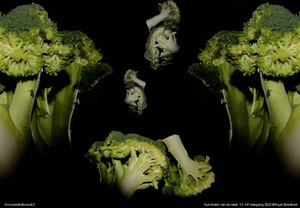
Cross-section Broccoli 2
2022Broccoli belongs to the Brassica Oleracea family. It is a cabbage of the type Acephela, of which the leaves and the flowering top are eaten. With this latter property it is related to the cauliflower but there are also clear differences. With cauliflower, the head or main umbel is formed by the precursors of the flower buds, the 'roses'. With broccoli, the umbel consists of already formed flower buds, which is why flowers quickly appear in a stump of broccoli and not in cauliflower. The head is very compact, and deep green to blue-green in color. Some varieties of broccoli have multiple main umbels, such as the Calabrese, with its wide branched stem the most sold species. Broccoli, by the way, sprouts again after harvesting. It forms successively new, smaller umbels, sometimes a number at a time. But in commercial cultivation it doesn’t come so far: after harvesting the umbels, the plant is grubbed up in the whole.
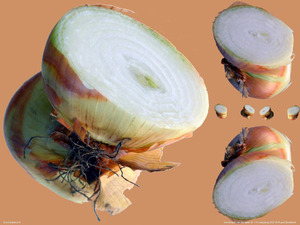
Cross-section Onion 8
2021Part of my 'Cross-section project' is the Onion. Onions are used worldwide in the kitchen as a vegetable and are found in all kinds of shapes and colors. The plant probably originates from Central Asia, although wild specimen have never been found there. Around 3000 BC, the onion was cultivated in China, India, Iran and Afghanistan. From India, it was brought to Greece and Egypt. The pyramid builders were given onions as a ration and in decorations and hieroglyphics in pyramids the onion is frequently depicted. After the introduction by the Romans, the onion quickly became popular as a vegetable in Europe. When cutted, onions have a sharp smell that even stimulates tear production. By cutting them, cells are destroyed which contain the enzyme alliinase, but also sulfur. Consequently sulfuric acid compounds are formed, from which the gas propaanthial-S oxide is released. In contact with the eye fluid, this gas irritates the nerve endings in the eye, causing them to water.
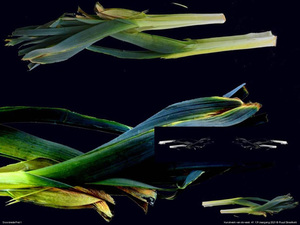
Cross-section Leek 1
2021This is part of my project 'Doorsnede' (Cross-section). The Leek plant originates from Eurasia and North Africa, but over 2000 years BC leeks were already cultivated by the ancient Egyptians and Greeks. The Roman emperor Nero loved leeks and the Romans spread the plant further across Europe, as far as the British Isles, where it became an important food-plant. As a result leeks became the national symbol of Wales. In the Netherlands, the leek prototype, also called tuber-leek in Dutch, was still fairly common around 1900.
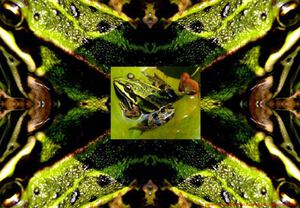
Frog 12
2021Every year we spot a frog in the small pond in our garden. This pool frog is the smallest of three species of green frogs that are found in the Benelux (pool- or small green frog, bastard- or middle green frog and lake- or large green frog). It has a grass-green to brownish colored back, often with a slight longitudinal stripe and sometimes with dark spots. Its white belly is only faintly mottled and males have white croak-bladders. It has relatively short hind legs and can grow to a maximum of 7 cm in size, but usually the length fluctuates between 4.5 and 5.5 cm.
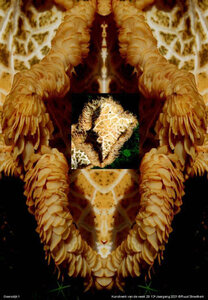
Geersdijk 1
2021On the edge of a lawn stands this beautiful mushroom. But we don't see what happens underground. The mushroom itself is the fruit-body and forms only a small part of the fungus, most of which is located underground in the form of fungal threads (hyphens), which together are called the mycelium. The rapid growth, the whimsical shapes and the colors of mushrooms were often attributed to sorcery in the past. For example, there are mushrooms with names (in Dutch) such as devil's egg, satanic bolete and witches bolete. A fairy ring is a naturally created circle of mushrooms, because the hyphens grow radially and the older fungal threads die. Some mushrooms, such as the champignon, are edible, but other species can be highly toxic, or have psychoactive or medicinal qualities.
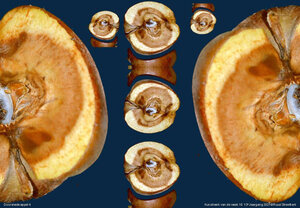
Cross-section apple 4
2021In my project Cross-section: the Apple. Apples are the fruit of the Malus Domestica, a member of the Rose-family. The fleshy fruit actually consists of three layers, of which two: the Exocarp and Mesocarp, are no longer distinguishable from one another. Together with the swollen flower base, they form the flesh of the apple. The Endocarp however is clearly distinguishable. It forms the core, containing the seeds, and in the middle the vascular bundle towards the stalk.
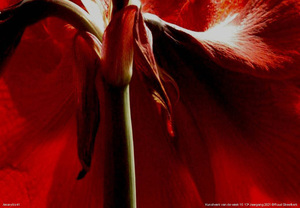
Amaryllis 41
2021The plants we call Amaryllis, actually belong to the genus Hippeastrum, a genus of bulbs from the Daffodil family. Its second name Amaryllis is used worldwide nowadays, but Hippeastrum is the correct botanical name. The plant originates from South America and has 4 to 6 flowers on a hollow stem. However, the real Amaryllis Belladonna is another plant, originating from South Africa, with 6 to 12 flowers and a solid stem. To make it more complicated, two Dutch growers moved to South Africa in 1946 to grow the South-Amarican Hippeastrum there. And up till now most cultivated forms of Hippeastrum come from the Netherlands or South Africa. Generally the Dutch bulbs produce flowers first and develop their leaves afterwards. The South African varieties develop their flower stems and leaves simultaneously. It is quite possible to winter the Amaryllis, provided it receives enough warmth and light in the summer and has a sufficiently spacious pot with nutritious soil. These ensure a good development of the bulb. If one doesn’t cut the leaves and allows the bulb a period of winter-rest, it will probably bloom again the following year.
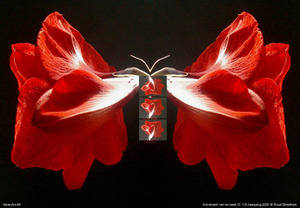
Amaryllis 48
2020The Amaryllis originates from subtropical areas with mild winters in South America, where it blooms in spring. Like our tulips, daffodils and hyacinths, the Amaryllis needs a winter rest before it blooms. By re-warming the Amaryllis after a cooler rest period, it will sprout once again and form flowers. So it is quite possible to winter the Amaryllis, provided it receives enough warmth and light in the summer and has a sufficiently spacious pot with nutritious soil. These ensure a good development of the bulb.
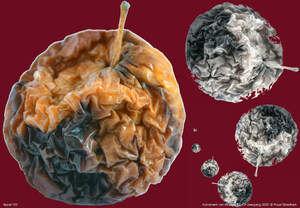
Apple 103
2020This is number 103 of my 'apple' project, in which I followed a gradually desiccating apple for a year. It begins smooth and soft, but just as in the human aging skin, wrinkles become grooves, and finally whole mountain ranges emerge, as on the surface of the earth or other planets. The apple is the fruit of the Malus Domestica from the Rose Family. The fleshy fruit actually consists of three layers, but in the apple these different layers are usually integrated. The core, containing the seeds, is the endocarp. The pulp is formed by both the mesocarp and the exocarp.
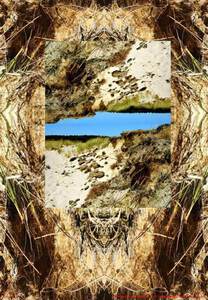
Dune pan 2
2020We are here in the dunes at Hargen, between Camperduin and Groet in North Holland. When Hargen is mentioned, one usually refers to the seaside resort Hargen aan Zee, because Hargen itself has hardly any village centre. But although the village has never been really large, it is actually a very old place. In the9th century it is referred to as Horgana, in the 10th century it occurs as Haragum and in the 12th century as Hargan. It is believed that the name was derived from Harag, which means sanctuary, which would refer to an ancient cult site of the Frisians, or to a place with dolmens (Hunebeds in Dutch), but these were never found here.
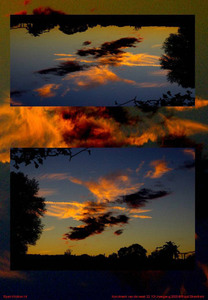
Epen Clouds 14
2020We are admiring a sunset over the valley at Epen (Limburg), one of the southernmost villages in the Netherlands. In Roman times, this area was already colonized. Legionnaires who served their time were assigned a piece of land, on which large Roman villas and farms were built, several of which are excavated. Since the late Middle Ages, the area suffered greatly from acts of war and from wandering gangs of deserted soldiers. Poverty was common, until around the two World Wars Epen was discovered by people with an interest in nature and geology. One of the first tourists was Eli Heimans, a teacher from Amsterdam and passionate nature propagandist. After holidays he spent in 1910 in Epen he wrote a booklet with the title From our Chalkland, by which the village gained more fame. Heimans was also one of the founders of the Association for the Conservation of Natural Monuments, together with the Maastricht-born Jac.P.Thijsse, author of well-known nature books at the time.