
Monuments
Monuments Built by human hands, such as churches, objects. castles, ruins, bridges, and so on have been working for this model.
dated 1992 until 2023
(click on an image to enlarge an artwork)
stuur een bericht
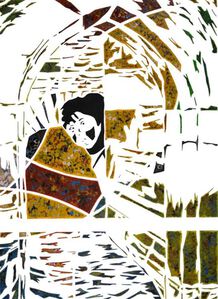
Ireland 2023
2023
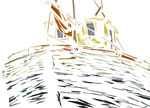
Boat Jakobselvkaia 1
2017On the coast of the Varanger peninsula, near the Varangerhalvøya Nasjonalpark (‘halvøya’ means half-island) which was established in 2006, on one of the northernmost points of Norway, lies the village of Jakobselvkaia. It is a fishing village with a small port. Everywhere around are conical piles of wooden posts, fishing nets hang to dry on high racks and old, obviously disused fishing boats are lying on dry land. The Varanger peninsula consists of grassy or stony plains (called 'blokkmark') and has a low mountain ridge with the 366m high Skipskjølen as its highest point. It has an Arctic flora and bean-geese, dwarf-geese and arctic foxes are living here. This is two of three works of these fishing boats.
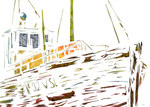
Boot Jakobselvkaia 2
2017On the coast of the Varanger peninsula, near the Varangerhalvøya Nasjonalpark (‘halvøya’ means half-island) which was established in 2006, on one of the northernmost points of Norway, lies the village of Jakobselvkaia. It is a fishing village with a small port. Everywhere around are conical piles of wooden posts, fishing nets hang to dry on high racks and old, obviously disused fishing boats are lying on dry land. The Varanger peninsula consists of grassy or stony plains (called 'blokkmark') and has a low mountain ridge with the 366m high Skipskjølen as its highest point. It has an Arctic flora and bean-geese, dwarf-geese and arctic foxes are living here. This is two of three works of these fishing boats.
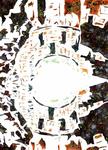
Coucy le Château
2017Coucy le Château On one of the last days of a trip to the South, I passed through the gate of Coucy le Château in Picardy in Northern France. The name Coucy comes from the Latin Codiciacum (probably derived from the word codex, which refers to a bare trunk with its branches removed). Because of threat of the Normans, the Archbishop of Reims built this castle in the 10th century on a hill surrounded with a wall. In the 12th century, under Enguerrand III, the castle was reconstructed in the form it has today. The threat of a conflict with the Crown, prompted the warlike Enguerrand to build a strong castle. From 1223 on, within a period of seven years, the whole complex, with donjon, towers, walls and underground passages, was constructed. The new building, with its almost 60 meter high donjon, controlled the northern passage to Paris, as well as the passage of the Valley of the Ailette to the Valley of the Oise, and was a conspicuous challenge to the French monarchs. Before the First World War the donjon of the castle was the highest reinforced tower in Europe, but the donjon, the four fortress-towers of the Castle and two entrance gates to the village, were blown up by the German army, when they retreated in 1917.
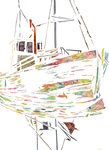
Jakobselvkaia
2017On the coast of the Varanger peninsula, near the Varangerhalvøya Nasjonalpark (‘halvøya’ means half-island) which was established in 2006, on one of the northernmost points of Norway, lies the village of Jakobselvkaia. It is a fishing village with a small port. Everywhere around are conical piles of wooden posts, fishing nets hang to dry on high racks and old, obviously disused fishing boats are lying on dry land. The Varanger peninsula consists of grassy or stony plains (called 'blokkmark') and has a low mountain ridge with the 366m high Skipskjølen as its highest point. It has an Arctic flora and bean-geese, dwarf-geese and arctic foxes are living here. This is one of three works of these fishing boats.
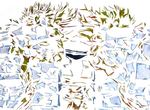
Cill Chriosd Church
2016In the broad valley of Swordale on the Isle of Skye in Scotland lies this ruin of the late-medieval church Cill Chriosd (Gaelic for the 'Church of Christ'). It's hard to imagine, standing at the remains of this little church in such a completely deserted landscape, that only a century ago this place was quivering with industrial activity. There were marble quarries, a railway line and a large factory. Nowadays nothing is to be found anymore of the factory buildings, the homes of the workers or the railway. The small church of Cill Chriosd has witnessed the rise and fall of all this human activity and with the exception of a few remaining scars in the landscape, it seems like nothing ever happened here. By now nature slowly but surely regained her rights here as well: the walls of the church are overgrown with ivy.
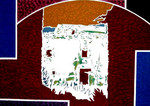
Tiermas
1993
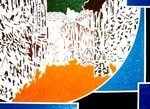
Tiermas Spanje
1993