
Polen
dated 2018 until 2023
(click on an image to enlarge an artwork)
stuur een bericht
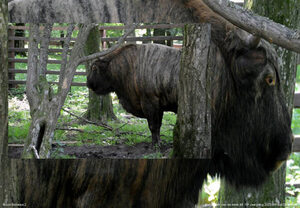
Bison bonasus 2
2023The Wisent or European Bison (Bison bonasus) is a mammal from the family of cloven-hoofed Bovidae. Along with the American Bison (Bison bison), wisents are the two last remaining species from the genus Bison. At the end of the 15th century the wisent in Europe had become so rare, that measures had to be taken in the form of hunting restrictions. This slowed down the process of extinction, but World War I brought the final blow for the species. The last wisents were seen in 1919. After World War I a successful attempt was made to rescue the species. A herd-book was kept and a breeding program initiated with wisents remaining in zoos and private collections. In 1952 the first reintroduction of wisents took place in the Białowieża primeval forest in Poland, now a National Park. The following year the same thing happened in the Belarusian part of the forest. Nowadays there are free living populations in Poland, Belarus, Ukraine, Russia, Lithuania, Slovakia, Romania and Germany.
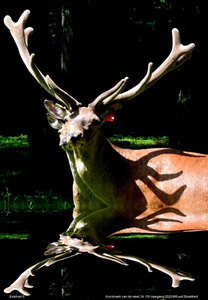
Red Deer 5
2023The Red Deer is active throughout the day, although in areas with much human activity, it is more likely that they turn up early in the morning and late in the evening. In the morning they usually move to grasslands to graze there. Red deer live in all sorts of areas, from dry deciduous forests and heaths to very moist environments as bogs and swamps. Only the male animal has antlers, which may become as large as 90 cm, weighing from 8 to 20 pounds. By the antlers one can approximately read the age. A young deer usually has smaller antlers with fewer tines, as well as deer in their last stage of life. A healthy animal has bigger and heavier antlers, but not necessarily with more tines than a sickly animal. There is a clear link between the quality of the habitat and the size of the antlers. In the17th century antlers were large, with 24 or more tines, but from then on population pressure, hunting and the planting of pine-forests, demanded their toll. After centuries of decrease the antlers of the red deer on the Veluwe in Holland got bigger again, because their living conditions improved after the second world war, by laying out wild fields, planting deciduous woods and promoting forest undergrowth.
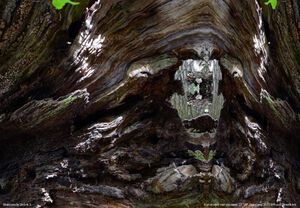
Białowieża Stump 3
2023This spring the media reported that Poland blundered by felling trees in the Białowieża Forest, one of the last remaining primeval forests in Europe. The forest, partly in Poland and partly in Belarus, was placed upon the Unesco World Heritage list. The Court of Justice of the European Union judged that Poland has not fulfilled its obligations arising from European directives for special nature protection. In the past 2 years, at least 10,000 trees were cut down and the Government has always claimed that the logging was necessary to prevent the spreading of a beetle plague (the 'pine-weevil'). But the European Court argues that the extent of the beetle plague does not justify the scale of logging and moreover, that they didn’t pay enough attention to the well-being of different inhabitant animal species. In our layman’s eyes the primeval forest didn’t look more spectacular than an ordinary forest, although young, old and fallen trees were mingled. I ran into this stump, decayed on the inside and covered with moss on the outside
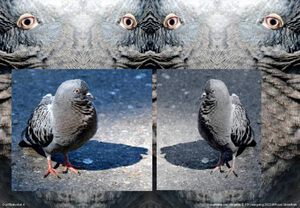
Duif Białystok 4
2023The Columbidae or of the family of pigeons, consists of medium-sized, compact built birds with a full, round chest and small head. Unlike other birds, they can absorb water with their beak. A dove broods about sixteen to twenty days in a simple, somewhat messy nest. When the young hatch, they are blind and covered with a thin down. The first days they are fed with 'pigeon milk'. This is a milky substance produced in the crop of both female and male pigeons. A few days before the eggs hatch, the inner layer of the crop of the pigeon is thickening. This is caused by the same hormone that stimulates the milk production in mammals. Eventually this layer comes loose and is released as a milky substance, which contains more fat and protein than cow's milk and is picked out of the crop by the young birds. After 3 to 6 days the eyes of the young open, after 11 days their feathers begin to grow and after 25 days they can fly. Men kept pigeons of old as poultry or carrier-pigeon.
Duif Białystok 2
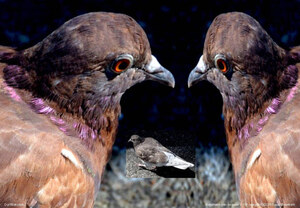
2023Doves (Columbidae) are a family of medium-sized, compact birds with a full, round chest and a small head. They have a fast, undulating flight. The male is called cock-pigeon and the female is called hen or just dove. Unlike other birds, they’re able to suck up water with their beak. The young are fed with so called pigeon’s milk from the crop. A pigeon-fancier is someone who keeps pigeons, but I presume they don’t milk them... A dove broods about 16 to 20 days in a simple, rather messy nest. When the young pigeons are born, they are blind and covered with a thin yellow down. After 3 to 6 days the eyes open and after 11 days they are feathered. The mother stops feeding them after about 16 days, then the young eat themselves. After 25 days they are able to fly.
Baltic Sea Polen 9
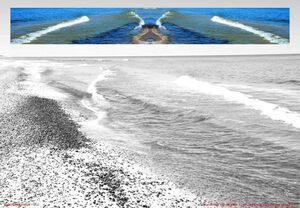
2022We are looking out over the Baltic Sea in Poland, a sea-arm of the North Atlantic Ocean. The word Baltic was probably derived from the Latin word for band or belt: balteus, and related to the Danish word 'Baelt' for strait.This large and brackish inland sea was formed by glacial erosion during the last ice age and has a lower salinity than the Atlantic Ocean, due to the barrier of the Kattegat in Denmark and the influx of more than 200 rivers. Because of its location and lower salinity, the Baltic Sea is usually frozen for about 45% in the winter, dependent on the temperatures. The freezing starts around mid November in the northern tip of the Gulf of Bothnia, where the ice gets up to 70cm thick, and reaches the open waters of the Baltic Sea near Stockholm at the end of December.
Baltic Sea Polen 7
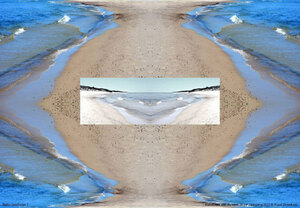
2022This is a part of the coast on the Baltic Sea in Poland. The Baltic Sea is a sea-arm of the North Atlantic Ocean, enclosed by Sweden, Denmark, Finland, the Baltic States and the northern European plain in Germany. It is one of the largest brackish inland seas, formed by glacial erosion during the last ice age. In Medieval times the sea was known under different names. The word Baltic was probably derived from the Latin word for band or belt: balteus, and related to the Danish word 'Baelt' for strait. On this stretch of beach on the Baltic Sea in Poland we see a layer of peat. On this spot stumps of an ancient forest of oak trees, 3000 years old, were exposed by the sea. By recent storms a few hundred meters of dune near the village of Rowy were washed away and revealed the tree stumps. They were probably destroyed by a large forest-fire. Because the stumps were covered in the course of centuries by salt water and sand, they remained almost intact as well as parts of the peat-soil in which they grew.
Paddenstoel Białowieża 5
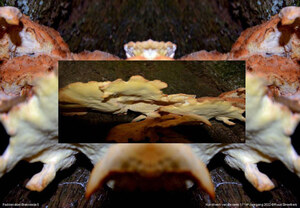
2022Mushroom Białowieża 5 Here in the border area of Poland and Belarus lies the huge forest of Białowieża, with a total area of 137,000 ha, of which 58,000 ha is located in Poland. This reserve is the largest and least affected primeval forest in the lowlands of Western and Central Europe. A good breeding ground for fungi such as this mushroom. The area has been a forest since the Ice Age, which is why the Poles call it Puszca (jungle). For centuries, the forest was owned by the Polish kings who used it as a hunting ground (a.o. on the Wisent). As a result, the forest was protected against clear-cutting. Although for example in World War I, the Germans cut huge amounts of timber from it. A part of almost 5,000 ha of the forest-reserve received the status of National Park in 1932, which was extended to more than 10,000 ha in 1996. The Belarusian part is also a National Park, but the protection is less clearly regulated than in the Polish part.
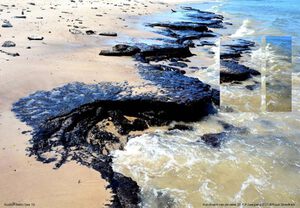
Baltic Sea Polen 3
2021We are looking out over the Baltic Sea in Poland, a sea-arm of the North Atlantic Ocean. The word Baltic was probably derived from the Latin word for band or belt: balteus, and related to the Danish word 'Baelt' for strait.This large and brackish inland sea was formed by glacial erosion during the last ice age and has a lower salinity than the Atlantic Ocean, due to the barrier of the Kattegat in Denmark and the influx of more than 200 rivers. Because of its location and lower salinity, the Baltic Sea is usually frozen for about 45% in the winter, dependent on the temperatures. The freezing starts around mid November in the northern tip of the Gulf of Bothnia, where the ice gets up to 70cm thick, and reaches the open waters of the Baltic Sea near Stockholm at the end of December.
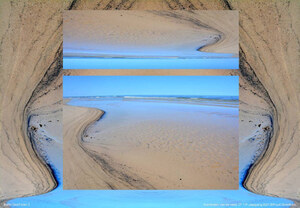
Coastline Baltic Sea 10
2021On this stretch of beach on the Baltic Sea in Poland we see a layer of peat. On this spot stumps of an ancient forest of oak trees, 3000 years old, were exposed by the sea. By recent storms a few hundred meters of dune near the village of Rowy were washed away and revealed the tree stumps. They were probably destroyed by a large forest-fire. Because the stumps were covered in the course of centuries by salt water and sand, they remained almost intact as well as parts of the peat-soil in which they grew.
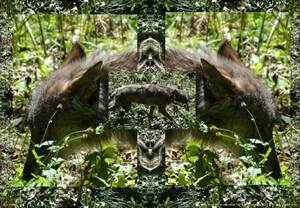
The Wolf 1
2021The wolf recently returned to the Netherlands, but in Poland they never vanished. Wolves are social animals that live in packs (family groups). A pack is led by an alpha male and alpha female. Usually these two have the exclusive right to reproduction. The food supply determines the group size. The offspring of the alpha pair usually remain in the pack for about two years and after that often spend another period with their siblings. The wolf has a wide variety of expressing capacities. The well-known howling is primarily intended to communicate over long distances, they can hear each other at distances of 6 to 10 kilometers. Within the pack communication mainly takes place by body language. Submissive wolves e.g. greet others by submission, with averted eyes, tail between the legs, low posture, ears back and a gentle whining. When they are angry or afraid, they usually show this with bare teeth and growling.
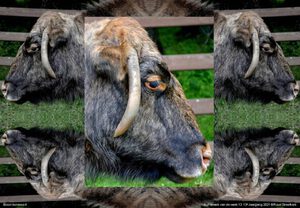
Bison Bonasus
2021This is a Wisent of European Bison(Bison bonasus) in the primeval forest of Białowieża in Poland, a National Park and World Heritage Site. I met this animal in a zoo situated in the forest. In 1919 wild wisents were extinct, but after breeding programs in various zoos, it was possible to re-introduce them in these primeval forests in 1952. As a result, there are now wild populations in Poland, Belarus, Ukraine, Russia, Lithuania, Slovakia, Germany and Romania. We were there in 2016, but whether that part of the forest is still there, remains to be seen…. Despite protests from all over the world, the Polish government intensified the timber-felling in the forest in 2015. The new management plan involves the felling of 188,000 m³ of wood instead of 63,000 m³ within 10 years, using the argument that a bark-beetle affects the pines and spruces, but just as many oaks and other tree species are cut down. Also 32 of the 39 scientists from the Council of Nature Conservation who criticized the felling plans, were dismissed and replaced by proponents.....
Moose 6
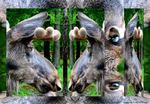
2019Moose are very large animals with a remarkable snout, a rough, grey-brown fur and long grayish-white legs which enable them to walk in deep snow. On females, the grayish-white fur covers the back right up to the tail. Adult males have a beard and antlers that may reach a span of 2 meters. Generally the antlers are broad, leaf-shaped, hoe-antlers with short protrusions, but there are also individuals with tine-antlers. The occurrence of both types is geographically defined: the bulls in southern Scandinavia more often have tine- antlers and in the North more often hoe-antlers. The old antlers are shedded off every year between December and March and grow back from April on. Moose have a highly developed sense of smell and hearing, but a limited sight. They have a preference for marshy areas and are excellent swimmers who are regularly found in the water.
Białowieża Stump 5
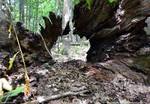
2018This spring the media reported that Poland blundered by felling trees in the Białowieża Forest, one of the last remaining primeval forests in Europe. The forest, partly in Poland and partly in Belarus, was placed upon the Unesco World Heritage list. The Court of Justice of the European Union judged that Poland has not fulfilled its obligations arising from European directives for special nature protection. In the past 2 years, at least 10,000 trees were cut down and the Government has always claimed that the logging was necessary to prevent the spreading of a beetle plague (the 'pine-weevil'). But the European Court argues that the extent of the beetle plague does not justify the scale of logging and moreover, that they didn’t pay enough attention to the well-being of different inhabitant animal species. In our layman’s eyes the primeval forest didn’t look more spectacular than an ordinary forest, although young, old and fallen trees were mingled. I ran into this stump, decayed on the inside and covered with moss on the outside.
Dębno 1
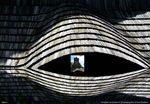
2018In this originally Slavic village in the Polish province of West Pommern, stands the St. Michael Archangel Church, dating from the second half of the 15th century. The Church is part of the Unesco World Heritage 'Wooden Churches of Southern Poland', and is one of the best preserved specimens of its kind. Apart from the original structure, it has kept its unique colorful interior, dating from 1500 as well. It is the oldest preserved polychrome decorated wooden church in Europe.
Red Deer 2
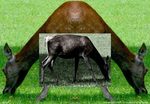
2018The primeval forest of Białowieża used to be the hunting domain of the medieval Polish kings and later on of the Russian Tsars. The forest was well managed and protected, making this the last area where wisents were to be found in the wild. In 1932 the forest became a National Park and in 1979 it was declared a Unesco World Heritage site. In the '90s the Belarusian part of the forest was added. On the Polish side as well as on the Belarusian side are zoological gardens where the animals are kept that once were native in the forest or once again native nowadays, such as this red deer. After the moose, red deer are the second largest deer-species in Europe. They are found in Western and Central Europe, from Spain to the south of Scandinavia. In the Netherlands red deer are to be found in several National Parks.
Grajewo
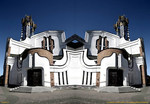
2018In the town of Grajewo in the province of Podlaskie, in North-Eastern Poland, I found this strange church in white and gold. One comes across many churches when driving through Poland, but this one actually stood out! After a good time searching on the internet, I found out that this is the church of 'Our Lady of Perpetual Help', designed by architect Tadeusz Zipser and built in the year 2000. It seems that the building is mentioned as second on a list of the ugliest Polish churches, but I found it a very interesting item! Podlaskie is a province, in Polish ‘Województwo’, an area originally administered by a ‘Voivode’ (commander/duke).
Hajnowka 8
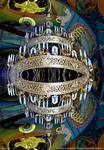
2018Hajnowka 8 The churches in Poland are generally richly decorated, with a beautiful example in the small town of Hajnówka on the Belarusian border. It is the largest town on the edge of the primeval forest of Białowieża. Due to its location, it is also known as the ' gateway to the Białowieża primeval forest '. The modern church of 'The birth of John the Baptist', which was built between 1995 and 2007, has a beautiful colorful interior, according to the Polish tradition of multicolored iconographic murals.