
Denmark
Denmark A quiet country with a long coastline and beautiful sloping cereal fields, where traces of the old Vikings can be found.
dated 2009 until 2023
(click on an image to enlarge an artwork)
stuur een bericht
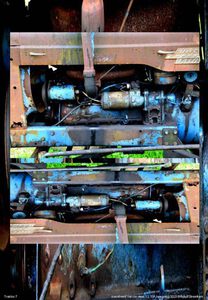
TRAKTOR 7
2023A tractor is a vehicle specially developed for agricultural use. The word tractor (derived from the Latin ´trahere´, which means ´to pull´) is a general description for a vehicle that can pull, push or drag another vehicle without propulsion. In the industrialized world, the tractor has almost completely taken over the role of draught animals on the farm and elsewhere. Carts may be hooked to the tractor, but also all kinds of agricultural implements for ploughing, sowing, fertilizing and harvesting. These tools are powered by the engine of the tractor, by linking them to a shaft. I came across this tractor near the village of Gørslev on the Danish island of Sjælland. I don't know if it is still in use, but it doesn´t seem to be the latest model....
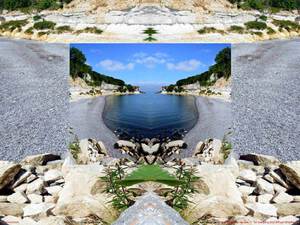
Stevns Klint 6
2023It's a beautiful day on the coast of Sjaelland in Denmark. Chalk cliffs with a length of 14.5 km and a height of up to 40m form the coastal strip of this island towards the Baltic Sea. The spot looks quiet and peaceful, but was that always the case? In the Cold War (in 1953) the Danish government secretly carved an underground fort (Stevnsfortet) into the chalk rock, with 1.6 km of corridors in which command centers, living quarters, ammunition depots, a hospital and a chapel were set up. The entire fort was located 18 to 20 meters below the surface. Among other things, due to deposits of Bryozoa (moss animals) in the lime, the Chalk cliffs have a high resistance to the impact of conventional and nuclear weapons. The fort remained in use until the year 2000.
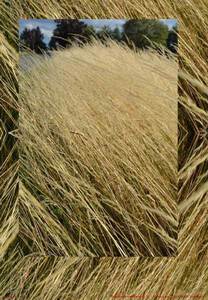
Strøby 4
2021We arrived near the town of Strøby, on the island Sjælland in Denmark. The name of the island is derived from 'seal' or from 'inlet/fjord', but was at an early age confused with the Old Danish word sjø, which meant 'sea' or 'lake', which is why the poetic form of Sjælland is also Sjøland. In the Prose Edda, a mythological Epic from Medieval Iceland, the island is called Selund. King Gylfi ruled the area now called Sweden. Legend has it that he promised arable land to a beggar-woman as a reward for how she had entertained him. The size of the plot was such, that 4 bulls could plough it over the course of a day and a night. But the king did not know that this woman was a goddess. Her name was Gefion. From the land of the giants she fetched 4 bulls and put them in front of the plough. However, these bulls were her sons, their father was a giant. They ploughed so hard and deep that the whole country came away from Sweden and ended up in the sea between Sweden and Denmark. There Gefion left it and she called it Selund. The place in Sweden where the land was ploughed away, became an inland lake with as many bays as there are headlands in Sjælland.
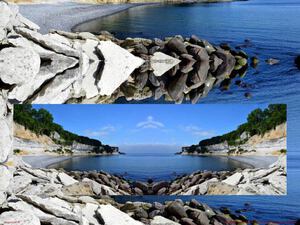
Stevns Klint 10
2021It's a beautiful day on the coast of Sjaelland in Denmark. Chalk cliffs with a length of 14.5 km and a height of up to 40m form the coastal strip of this island towards the Baltic Sea. The spot looks quiet and peaceful, but was that always the case? In the Cold War (in 1953) the Danish government secretly carved an underground fort (Stevnsfortet) into the chalk rock, with 1.6 km of corridors in which command centers, living quarters, ammunition depots, a hospital and a chapel were set up. The entire fort was located 18 to 20 meters below the surface. Among other things, due to deposits of Bryozoa (moss animals) in the lime, the Chalk cliffs have a high resistance to the impact of conventional and nuclear weapons. The fort remained in use until the year 2000.
Drops 2
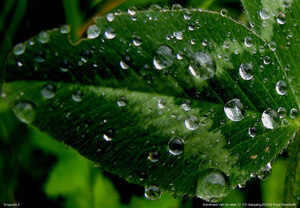
2020On this leaf lie drops of water. A small amount of liquid in a void, i.e. in the air, takes on a spherical shape. This spherical shape is created by the natural cohesion of the molecules in the liquid. They attract each other and arrange themselves as close as possible, resulting in a spherical shape. A drop attached to an object is generally pear-shaped and when lying on a surface, it forms half a sphere. Moreover, the drops on the leaf mirror their surroundings
TRAKTOR 2
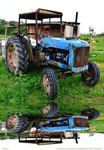
2017A tractor is a vehicle specially developed for agricultural use. The word tractor (derived from the Latin ´trahere´, which means ´to pull´) is a general description for a vehicle that can pull, push or drag another vehicle without propulsion. In the industrialized world, the tractor has almost completely taken over the role of draught animals on the farm and elsewhere. Carts may be hooked to the tractor, but also all kinds of agricultural implements for ploughing, sowing, fertilizing and harvesting. These tools are powered by the engine of the tractor, by linking them to a shaft. I came across this tractor near the village of Gørslev on the Danish island of Sjælland. I don't know if it is still in use, but it doesn´t seem to be the latest model....
TRAKTOR 6
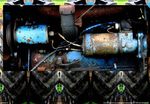
2017Behind a tractor all sorts of agricultural implements or wagons may be attached. The coupling should be lower than the rear axle. If not, there is a risk that the tractor skips when the cart gets stuck. Many farmers however, take the risk and opt for a higher coupling, because this generates more tractive power. Vehicles are sometimes connected slightly besides the tractor, in order to protect the soil from too much compression, but the wheel pressure may also be reduced by a 'twinned' pair of rear tires, so the tractor gets more grip and will subside less quickly . Nowadays extra wide tires are used, even to a meter wide, to reduce the pressure. More pressure means deeper tracks and damage to the soil structure or to the crop, which should be avoided as much as possible.
Drops 1
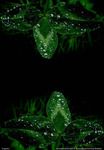
2015After a rain-shower these drops remain on the leaves. A drop is defined as a small amount of liquid, which assumes a spherical shape when it is completely enveloped by free space or lying on a free surface. This form develops because the molecules of the liquid attract each other. Due to this cohesion, they arrange themselves as close as possible, resulting in the spherical shape. There are several proverbs making use of the word ‘drop’, like: 'one catches more flies with a drop of honey than with a barrel of vinegar ', in other words: a kind word has more impact than a long, angry tirade. Or something is just 'a drop in the ocean ': a remedy that is hardly sufficient to redress a problem.
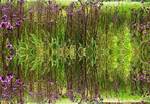
Gørslev 1
2015This field full of Welted Thistles lies near the village of Gørslev on the island of Sjaelland in Denmark. There are many plants of which the name ends with thistle, but many of them don’t belong to the same genus, or even to the same family. Real thistles are prickly plants with flowers surrounded by pointed leaves, usually in shades of red to purple. The fruits are furnished at the top with fluff, by which the seeds spread on the wind. Thistles are biennial plants. In the first year there is only a root- and leaf-rosette, the second year the flowers and seeds develop.
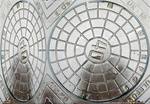
Manhole cover 27
2013This is a work from my 'manhole cover-project'. I collect photos of manhole covers from various towns and villages in Europe. This one is located in Frederikssund in Denmark. A manhole cover shuts off a well and is usually made of heavy metal. In general old covers are square, whereas modern ones are round. Whatever form they have, all lids are embossed to create grip. The reason for the switch from square to round was that a round manhole cover will never fall into the pit. A square one could (diagonally/vertically) fall in its own pit and that would be life-threatening for someone working in the shaft. In addition, round lids weigh less than square ones with the same diameter. Despite of the fact that the manhole cover itself may be round, the iron frame around the pit is almost always square to fit with the paving around it. Round frames are only used if the well is laid in asphalt. When cars drive over a manhole cover, it should not be lifted up by vibrations. But a race car is pressed so strongly against the surface of the road by its aerodynamics at high speed, that low air pressure occurs under the car, which is strong enough to lift a manhole cover. So in street races with formula-1 cars manhole covers are usually firmly welded.......Well, well, well, we might conclude that there’s a lot to learn about manhole covers☺!
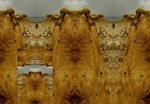
Helnæs Bugt 14
2012These coastal dunes of sand and gravel along the Helnæs peninsula on the island of Funen in Denmark, gradually crumble away in the sea of the Akrog Bugt. Components of the shore solve by the rippling and sometimes pounding waves at the water-level, causing the soil above to crumble into the water. Funen is Denmark's largest island after Sjælland. Nowadays it is connected by bridges and tunnels with Jutland and Sjælland.
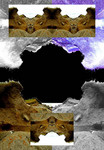
Helnæs Bugt 16
2011This work is called Helnæs Bugt. It was created on the Helnæs Peninsula, which is part of the island of Funen in Denmark. But actually this is more a view of Akrog Bugt, the South West side of Helnæs, where the sea is constantly washing away the low dunes of sand and gravel.
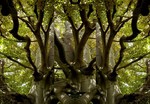
Louisiana 2.
2011
Louisiana 2.
The Louisiana Museum of Modern Art is the main museum for modern art in Denmark. It is located in the village of Humlebæk, about 35 kilometers north of Copenhagen, on the hilly banks of the Sont. The museum is housed in a 19th-century mansion, which was converted into a museum in the 1950’s. Later progressively more rooms were added. The visitor traverses different levels during his visit, and always has access to- and a view on the world famous sculpture park and on the water of the Sont. This centuries-old beech tree grows in the sculpture park.
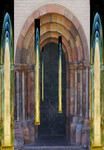
Deur 51
2010Deur 51: This is the door of the Cathedral in Ribe in Denmark. It is obvious that a door serves to protect us from intruders or the cold, but also invites us to enter the restricted space behind it. The door is the symbol of this contradiction: both secrecy and openness to the world.
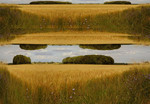
Møns Island 9
2009Møns Island, 9: waving grain on the island of Møn in the South of Denmark.
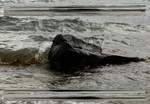
Zee 10
2009‘Sea 10’: Waves beating on the rolling stones on the coast of the Helnæs Peninsula in Denmark.
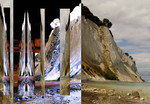
Møns Klint 1
2009‘Møns Klint 1’. These wonderful chalk-cliffs on the east coast of the island of Møn in Denmark are about 400 metres high.
Lucht 2
2009‘Lucht 2’. The beauty of the clouds over the Peninsula of Helnæs in Denmark.