
Schotland
this file contains works of art which are based on impressions of my journey through England and Scotland, including a.o. the Scottish Highlands, the coast and English and Scottish gardens.
dated 2020 until 2023
(click on an image to enlarge an artwork)
stuur een bericht
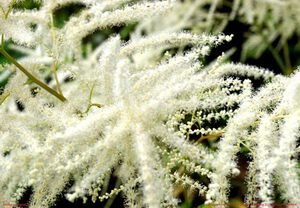
Astilbe chinensis 2
2023In the Inverewe Garden on the North-West coast of Scotland, I came across this Astilbe Chinensis. The genus Astilbe originates from Asia, but very soon it became well-known in other parts of the world and all kinds of hybrids were bred. This Chinese Astilbe ' Milk and Honey ' blooms in August and has elegant fluffy white blossoms, above attractive shiny bronze-tinted leaves.
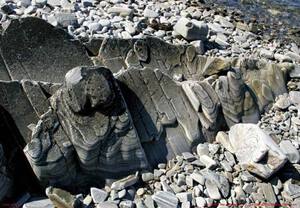
Loch Ailort 9
2023It is obvious that the waves played havoc in the sea-arm of Loch Ailort, in the southern Highlands of Scotland. In its mouth lies the island of Eilean nan Gobhar, which is famous for two vitrified forts. These forts have the peculiarity that the boulders from which they are built, are fused by the application of intense heat, so that they are firmly glued together. Often pieces of stone are wrapped in a glassy, enamel-like layer. But it doesn't necessarily make the walls stronger. Combat damage is unlikely to be the cause, as the walls must have been exposed to carefully maintained fires, which were hot enough to cause such vitrification. Today, experts explain vitrified fortresses as the product of deliberate destruction, as an act of ritual closure after the capture of the site by a hostile force.
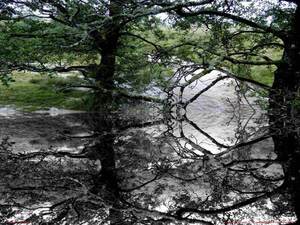
Fulford, Lockerbie 4
2023We are here in Dumfries and Galloway, in the south-west of Scotland, near Lockerbie. It was raining all night and day, causing several roads to become completely flooded. We had to drive through it, but as a result one of the tires of our car was seriously perforated by the sharp point of a broken tree branch. Fortunately, a truck driver who lived there in the middle of nowhere, helped us to get a new tyre! Lockerbie is known for Pan Am Flight 103: a Boeing 747, en route from Frankfurt to New York, that had just made a stopover in London. Shortly after 7 p.m., the plane disappeared from the radar. It was flying at an altitude of 10 kilometers at that time and was torn apart by an explosion in the luggage compartment. A burning wing came down in a residential area of Lockerbie. All 259 passengers and crew as well as 11 inhabitants of the village were killed. How important is a branch in your car-tire then…..
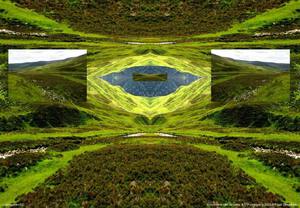
Cairngorms 12
2023The Cairngorm Mountains in the Scottish Highlands have a unique character. The massif consists of a large granite plateau with relatively high valleys and old forests on the lower flanks. The climate, landscape and ecological conditions on the storm-swept plateau are similar to those in the Arctic. One will find a tundra-like landscape here, with arctic and subarctic flora and fauna. This mountain range has the highest amount of peaks in the whole of Scotland. Four of them are above 1220 meters. The Cairn Gorm itself, after which the mountain-range was named, is 1245 m high, in Gaelic this means 'blue peak'.
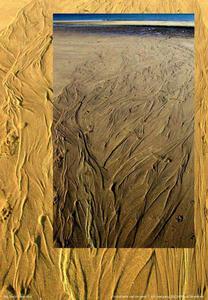
Big Sand Gairloch 4
2023A strip of sand at Gairloch in Scotland. At low tide, the tracks that the retreating water leaves behind, cause these lines. Since the 15th century this area was in the possession of the Mackenzies of Gairloch. The Mackenzies were clan leaders in the traditional sense of the word and were known for the commitment to their tenants. In the 19th century Sir Hector Mackenzie refused to evict any of his sharecroppers during the so called Highland Clearances, despite the fact that the estate made a loss. In those days the population was forced by the feudal landlords to leave their land because they had discovered that a new agriculture - based on sheep - would be more profitable. Many evicted Highlanders from other communities took refuge in Gairloch, turning it into a thriving community, which it remained to this very day. The Mackenzies were also enthusiastic gardeners. Because of the warm Gulf stream a mild micro-climate reigns here, which is the cause of a wide range of flora and fauna. Descendant Osgood Mackenzie created the famous Inverewe Garden in nearby Poolewe.
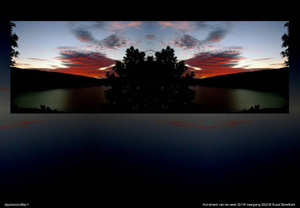
Applecross Bay 1
2022At nightfall we see the clouds over the coast of Applecross turn red. How did this place come about? The area in and around Applecross is said to be one of the earliest inhabited areas of Scotland. The hamlet of Sand, on the coast, is an important archaeological site. Historically, Applecross is associated with St. Máelrubai, an Irish monk, who had come to the British Isles in 671 to found an abbey in then Pictish territory. He names the settlement Aporcrosan (Pictish: confluence of the River Crossan). St. Máelrubai was the first abbot, he attained the age of 80 years. Many churches on Skye and in Northern Scotland are dedicated to this saint, for example the church on the holy Isle Maree (in Gaelic: Eilean Maolruibhe).
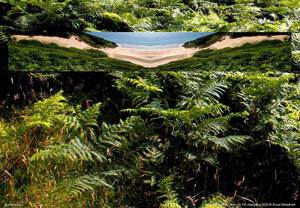
Applecross 2
2022On the North-West side of the Highlands in Scotland we arrive at a small beach just before Applecross. Extremely isolated, Applecross was accessible only by boat until the early 20th century, and for many years after that the only road access was over one of Scotland's most notoriously treacherous roads, the Beaalach na Ba ('Pass of the Cattle'), which crosses the peninsula and reaches a maximum height of 626m, below the 792m high mountain Sgurr a' Chaorachain. Only in 1975 the settlement was connected via a winding coastal road. The Beaalach na Ba is a challenge for many motorists and motorcyclists, whose destination often is the Applecross Inn, one of the buildings in a row of houses on the coast. The name Applecross applies to all the settlements around the peninsula, and this row of houses which is often referred to as 'Applecross', is actually called 'Shore Street' and is referred to locally just as 'The Street'.
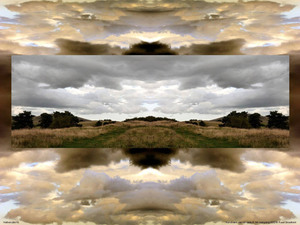
Haltwhistle 15
2022The Hadrian Wall in Scotland was built by legionnaires. The western part (46 km) was 3m wide and was initially made up of slabs, earth and wood. That part was later replaced by a stone wall. The eastern part (73 km) was built in stone from the beginning. The stones were extracted in nearby quarries and were roughly tooled. Later built parts of the wall were about 2.3m wide. The height was probably between 3.6 and 5m. At fixed distances 80 smaller forts or 'mile castles' were built. Between these mile castles, which had a gate and were about a Roman mile apart (+ 1.5 km), two more watchtowers were built. Presumably, the gates in the wall served as customs posts, in order to be able to control the trade. Only in the second instance, a few years after the start of the construction, about 15 larger forts were built along the wall, which were connected by a Roman road.
Haltwhistle 11
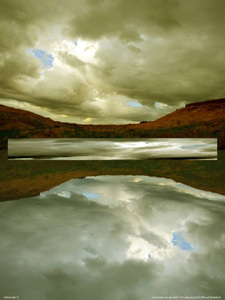
2022The Hadrian Wall in Scotland was built by legionnaires. The western part (46 km) was 3m wide and was initially made up of slabs, earth and wood. That part was later replaced by a stone wall. The eastern part (73 km) was built in stone from the beginning. The stones were extracted in nearby quarries and were roughly tooled. Later built parts of the wall were about 2.3m wide. The height was probably between 3.6 and 5m. At fixed distances 80 smaller forts or 'mile castles' were built. Between these mile castles, which had a gate and were about a Roman mile apart (+ 1.5 km), two more watchtowers were built. Presumably, the gates in the wall served as customs posts, in order to be able to control the trade. Only in the second instance, a few years after the start of the construction, about 15 larger forts were built along the wall, which were connected by a Roman road.
Applecross Formation 3
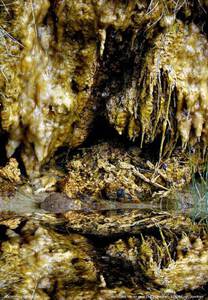
2020Shallow tropical seas are the ideal breeding ground for calcium carbonate, which is deposited on the ocean-floor by the remnants of organisms that live in the warm water in sufficient sunlight, such as coral, algae and shells. These lime residues are naturally ground by strong currents and waves and the remaining sand is deposited on the seabed. It takes thousands to millions of years to form limestone from these deposits, due to the fact that the sediment has to be compacted by the pressure of deposits on top. In this area in Scotland, the vegetation and moisture on the chalky soil have created a spongy marshland. Small streams drain the water towards the sea. Along the banks of such a stream, the chalky water drips down and forms a miniature landscape of small stalactites over the years.