
Ierland
Ierland
dated 2022 until 2023
(click on an image to enlarge an artwork)
stuur een bericht
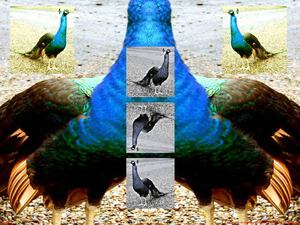
Peacock 1
2023More than 4000 years ago, the peacock reached Europe via Mesopotamia. It is a fowl belonging to the family of pheasants. The rooster is characterized by a long and imposing tail. There are two species: the blue peacock (Pavo cristatus) and the green peacock (Pavo muticus). The female of the blue peacock is rather inconspicuously colored. With the green peacock there is less distinction between the two sexes. The roosters of both species have a long trail, consisting of about 150 colorful and strongly elongated tail-coverts, which show a peacock-eye at their ends. If the rooster ruffles its trail to conquer a female, the feathers can be seen most clearly. Originally kept in parks and gardens for their beauty, roasted peacock soon became a culinary status symbol! In addition, the feathers were highly in favor as a 'dry bouquet' or decoration of women's hats. Also in the Empire of China and in Manchuria, a peacock feather on the hat was a high distinction. Peacocks appear in ancient folk tales, in which they are associated with love and the gods.
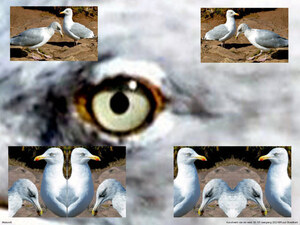
Gull 6
2023Most Gulls are carnivores. They eat both bait and live preys. Their prey usually consists of crabs and small fish. Generally gulls are birds of the coast and open inland and they will rarely be found far out at sea or in forests. The larger species have a very high life expectancy: there is a case known of a herring gull that proved to be 49 years old. Gulls nest in large, densely packed and noisy colonies. They lay two or three speckled eggs in a nest made of plant material. The young are born with dark spotted down and they are nidifugous: they’re able to walk immediately. The larger species get their adult plumage only after four years, the smaller species after two years. Gulls are ingenious, curious and intelligent birds and they have adapted themselves successfully to the human environment. They use complex communication methods and have highly developed social structures. In many colonies one can observe for instance a defensive nagging-behavior, with which potential rivals are kept at a distance. Some species, such as the herring gull, have even developed skills to use tools.
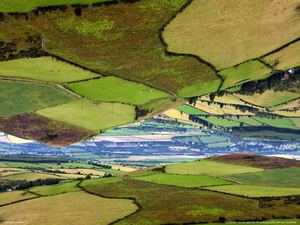
Greenan Mountain 10
2022From the Grianan of Aileach, a large Ringfort right on the border of Northern Ireland and the Republic of Ireland, you have a wide view of Donegal and the Inishowen peninsula. The Greenan Mountain is 244 m high and consists mainly of sandstone and slate, covered with marsh and heather. The Ringfort on the top dates from the 6th century, but probably the hill was already used long before that time, because just outside of it, the remains of a Neolithic Tumulus and a well were discovered. The fort consists of 3 terrace edges with a thickness of 4.5 m. Originally there were buildings inside: they were the seat of the Celtic kingdom of Aileach, which in the12th century lost much of its power and territory to invading Normans.
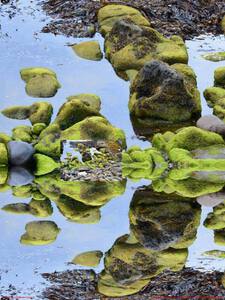
Causeway Coast and Glens 9
2022We are on the Atlantic coast in Northern Ireland. The stones are overgrown with moss and algae. This district is named after two of Northern Ireland's most visited tourist attractions: the Giant's Causeway on the north coast, consisting of some 40,000 basalt columns created by a volcanic eruption some 60 million years ago, and a World Heritage Site since 1986. And secondly to the Glens of Antrim: nine river valleys that descend from the Antrim Plateau to the coast. The Glens are also a major tourist attraction in northern Antrim.
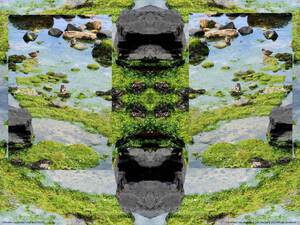
Ducks Causeway Coast and Glens 5
2022On this coast with its rocky underground, ducks are quietly feasting on the thriving green algae. This district: The Causeway Coast and Glens, is located on the north coast of Northern Ireland and borders from northwest to northeast on Lough Foyle, the Atlantic Ocean and the North Channel. Rathlin Island, which lies off the coast, also belongs to this district. Its name is partly derived from the Giant's Causeway, a geological rock-formation and much frequented tourist attraction on the coast.