
The animal
The animal It is always interesting to see how the life in types of many forms. The unique beauty of each animal, both of If a House mite, or detail.jpg of a fish.
dated 2019 until 2026
(click on an image to enlarge an artwork)
stuur een bericht

Rendier
2026

vossen
2026

Marmot
2026

Vlieg
2025

Nachtvlinder
2025

Nest 2025
2025tweeluik

Larve Aziiatisch lieve heersbeestje 2025
2025Larve Aziiatisch lieve heersbeestje 2025

Huidvleugelingen 2025
2025Huidvleugelingen 2025

Rode Wegslak 2025
2025

Bont Zandoogje 2025
2025Bont Zandoogje 2025

Muisstil 2025
2025Tweeluik
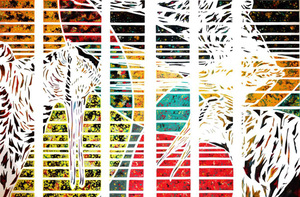
Houtsinp 2025
2025Houtsnip 2025

Spotted Woodpecker 2024
2024The great spotted Woodpecker is a fairly large bird, with a length of about 25 cm and a weight of of about 100 grams. His back is black with large oval, white shoulder patches, the flight feathers are barred with black and white, and the underparts are colored white and crimson. The bill is slate black and the legs are grey. The male has a crimson spot on the nape, which is absent in females. The food consists of insects and grubs, especially the larvae of beetles living under the bark of pine trees, but also of fruit, nuts, berries and seeds of coniferous trees. It often chops a hole in a tree in order to clamp a pine-cone in it, a so called ‘woodpeckers forge’. Nowadays the great spotted woodpecker has a special enemy: Ring-necked parakeets, originally from India, but as an escaped cage bird recently gaining more and more territory in Netherlands, who chase the woodpeckers from their nesting holes. Nevertheless, there is no evidence yet that the parakeet has a negative impact on the population of the woodpeckers. On the contrary they proliferated over the last years.
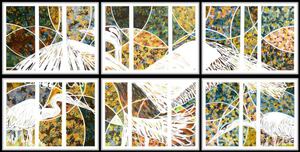
Reiger 2024
2024Reiger
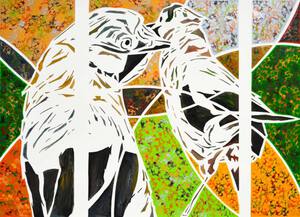
Kramsvogel-2023
2024Kramsvogel-2023
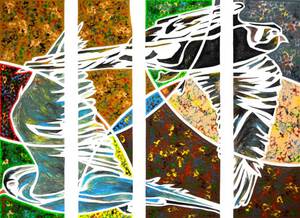
Valk-2023
2024Valk-2023
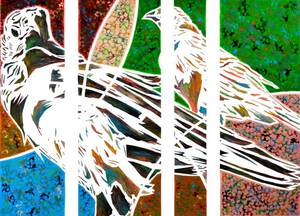
Kraai-2023
2024Kraai-2023
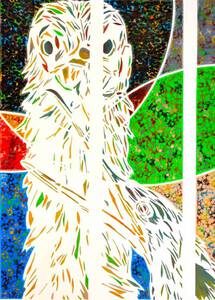
Cormorant 2023
2023The cormorant is 80 to 100 cm long and has a wingspan of 120 to 150 cm. It has webbed feet and catches fish by diving. The beak is long and has a hook-shaped tip. The feather suit seems black, but actually it’s largely deep bronze green. Each feather of the upper wings has a subtle black fringe, which gives the bird a scaled appearance. In the spring, their cheeks and thighs are feathered white, the crown and neck are provided with silvery white mane and the unfeathered throat turns yellow. This gay dress fades away during the breeding season. They are migratory birds: in severe winter weather, cormorants from the Netherlands migrate south to the Mediterranean, while cormorants from the Baltic sea region and northern Germany hibernate here.
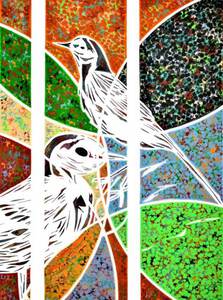
White Wagtail
2023White Wagtails are very lively small birds. Their flight is wavy and on the ground the graceful tail wags up and down continually. They are also fairly aggressive and sometimes ‘fight’ with their own reflection, for instance in a shiny hub cap of a car. In the winter they migrate Southward, but many birds in Northern and Eastern Europe migrate only to the West, to benefit from the relatively warm sea-climate. In the winter the bird generally lives in small swarms that are often seen on farmland.
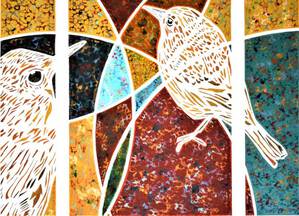
Rock Pipit 2023
2023Strolling along a small beach in Brittany (France) I see a small bird scrubbing between the washed up seaweed. It turns out to be a rock-pipit (Anthus petrosus): a small bird (15.5 to 17cm long) from the family of pipits and wagtails. It is mainly found on the coast, near salt water, in salt marshes and along piers, in ports and on basalt blocks and dikes. It breeds on rocky seacoast and islands with low vegetation. In the period September-November (mainly during daytime) some 1000 birds from Scandinavia migrate to the Netherlands to spend the winter on the Dutch coast, especially in the Delta and the Dutch Shallows. Sometimes they reach Brittany, and some individuals even fly to Spanish and Portuguese coasts. From March-April they all return to the north.
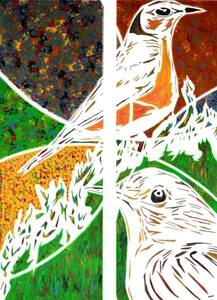
Nightingale 2023
2023In a dune strip in Brittany we thought we heard a nightingale. The nightingale prefers to stay in dense shrubs and is therefore difficult to spot. They have a very exuberant singing, but a subtly colored plumage: the upper side is warm brown with orange-brown tail-feathers. The underside is grey-brown with a slightly lighter throat. This took place in September, so I suspected the bird was on its way to Africa. From July on they migrate southwest over France and the Iberian Peninsula to tropical Africa. By mid-September most of them have left and they return in mid-April. The Netherlands form the northern edge of the nightingales area. Their menu consists of all kinds of animal food: insects, earwigs, spiders, daddy-longlegs and earthworms, supplemented with various types of berries. They forage walking on the ground, often in dark spots under brushwood.
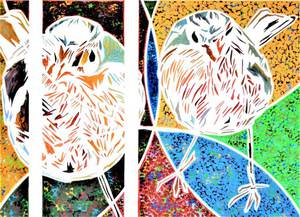
Robins 2023
2023This rather squatty little bird, which according to the nursery rhyme, taps against the window: 'tap, tap, tap, tap, please let me in, please let me in...' sings from early in the morning when it is still dark. In case of danger, it emits the cry 'tsik'. Both males and females fiercely defend their territory against congeners. But actually they desperately need that territory to find enough insects to survive. Therefore, they will fight and expel other robins entering their habitat. It is mainly the red breast that generates recognition and aggression. This aversion to the color red is anchored so deep in the nature of the robin, that it would rather not have a red toy car or ball in ‘his’ garden. And because most birds do not recognize themselves in their reflection, they are also aggressive towards their own image, hence the song of the robin tapping against the window!
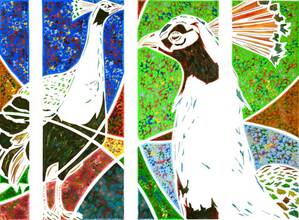
Peacock 2023
2023More than 4000 years ago, the peacock reached Europe via Mesopotamia. It is a fowl belonging to the family of pheasants. The rooster is characterized by a long and imposing tail. There are two species: the blue peacock (Pavo cristatus) and the green peacock (Pavo muticus). The female of the blue peacock is rather inconspicuously colored. With the green peacock there is less distinction between the two sexes. The roosters of both species have a long trail, consisting of about 150 colorful and strongly elongated tail-coverts, which show a peacock-eye at their ends. If the rooster ruffles its trail to conquer a female, the feathers can be seen most clearly. Originally kept in parks and gardens for their beauty, roasted peacock soon became a culinary status symbol! In addition, the feathers were highly in favor as a 'dry bouquet' or decoration of women's hats. Also in the Empire of China and in Manchuria, a peacock feather on the hat was a high distinction. Peacocks appear in ancient folk tales, in which they are associated with love and the gods.
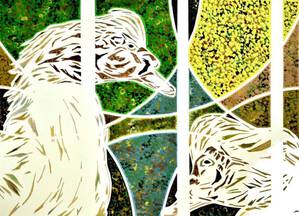
Goose
2023We are camping on a farm-campsite called Maddybenny on the Causeway Coast in Northern Ireland, surrounded by a variety of free-range poultry: chickens and geese, peacocks and horses, cows and a donkey. The word goose actually denotes a female goose. The male is called gander. Geese are large, heavily built waterfowl from the family Anatidae (swans, geese and ducks). They specialize in grazing and dwell more on land than other Anatidae. Consequently they have strong, rather long legs, placed in the middle of their body, which allows them to walk well. Geese can live up to 30 years. They are fertile from the age of 3. Unlike ducks, the males and females have the same plumage, but the difference is noticeable because the female has a larger potbelly than a male, especially obvious in the breeding season.
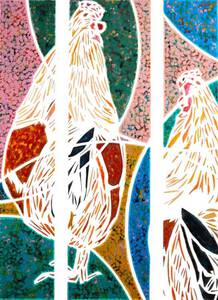
Rooster
2023Jaunty, this rooster steps away from us. The behavior and appearance of a rooster differs substantially from that of the hen. Roosters have a strong natural tendency to defend their territory, and they do so by crowing. The rooster begins crow when it is fully fledged, by 14 to 20 weeks, depending on the species. In free-roaming chickens, the rooster takes on a watchful role and warns for birds of prey and other danger. Unlike hens, which flee or remain silent in the face of danger, he makes himself great and even defends them against much larger enemies. When he finds a ´titbit´, he will initially call the hens with special cluck-sounds. If they do not come, as yet he will eat the snack himself and if the chickens quarrel with one another, he jumps in between, so a group of chickens with a rooster is usually quieter than one without.
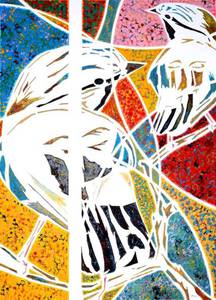
Jay
2023The Jay is found a.o. in the Benelux. The appearance of the bird is predominantly gray-brown with a pink shade. The throat, abdomen, tailbone and part of the hand-pins are white. Characteristic are a black mustache stripe and light blue feathers in the wing with fine, black stripes. When aroused, the bird can erect its crown feathers, these are alternated light and black. Jays eat a wide spectrum of animal- and vegetable food. The scientific name Garrulus glandarius can be freely translated as the constantly scratching acorn seeker. And indeed the oak largely depends on them for spreading its acorns: the jay transports them to spots with a soft surface, where it pushes them into the ground. This is how it builds up a winter stock. But it usually forgets a few spots and what is not found can develop into a new oak tree. For this reason, the jay is also called 'the great forester'. The German name for the jay (Eichelhäher) typifies this behavior.
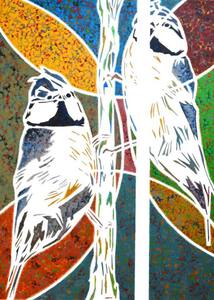
Great Tit
2022It is not very unique to have a number of Great Tits in our garden, after all, there is a bird peanut-butter-pot and often something for them to eat. The Great Tit is one of the most common and well-known breeding birds in the Netherlands. It has a varied vocabulary of songs and is easily recognizable by its yellow body and black head. It is common in deciduous forests, but also in villages and towns. It eagerly uses additional feeding in winter, although in severe winters large mortality can occur. It broods from the end of April, has 1 or 2 clutches per year with 8-13 white (spotted with red) eggs. Great Tits are cave-breeders but they often use nest boxes and are sometimes completely dependent on them. Neighboring nests are sometimes located 3-4 meters away. The nest is made by the female and consists of grasses, moss, animal hair, wool and feathers. The female begins to breed when 8-10 eggs have been laid. Breeding duration is 13-15 days. Chicks are fed by both parents, and the young remain on the nest for 18-21 days. After they have flown out, they are fed for another 2-3 weeks. The Great Tits in Holland are resident birds and therefore hibernate in our country. In harsh winters, Great Tits from Scandinavia and Eastern Europe come to the Netherlands in large numbers. This autumn migration of hibernators takes place between mid-September and mid-November, the spring migration takes place almost imperceptibly between mid-February and mid-April.
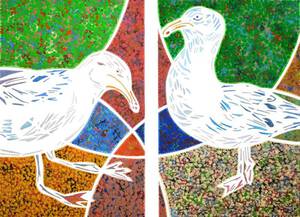
Gull
2022Most Gulls are carnivores. They eat both bait and live preys. Their prey usually consists of crabs and small fish. Generally gulls are birds of the coast and open inland and they will rarely be found far out at sea or in forests. The larger species have a very high life expectancy: there is a case known of a herring gull that proved to be 49 years old. Gulls nest in large, densely packed and noisy colonies. They lay two or three speckled eggs in a nest made of plant material. The young are born with dark spotted down and they are nidifugous: they’re able to walk immediately. The larger species get their adult plumage only after four years, the smaller species after two years. Gulls are ingenious, curious and intelligent birds and they have adapted themselves successfully to the human environment. They use complex communication methods and have highly developed social structures. In many colonies one can observe for instance a defensive nagging-behavior, with which potential rivals are kept at a distance. Some species, such as the herring gull, have even developed skills to use tools.
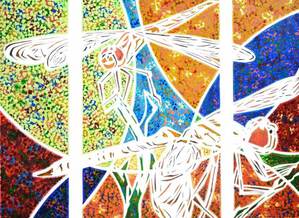
Dragonflies
2022Dragonflies (Anisoptera) belong to the order of winged insects. They are medium to large insects that are easily recognizable by their long, segmented and very pliable abdomen and the wide wings with which they can fly very skilful. The four wings are not connected to each other, as with many other insects. This allows the wings to move separately from each other and enables the dragonfly to perform remarkable tricks, such as standing still in the air, taking off vertically and even fly backwards. At 20 to 40 beats per second, the wing-beat is much slower than in other, smaller insects. The most striking characteristic of its head are the compound eyes that consist of 10,000 to 50,000 facets. With these eyes they perceive movement, the upper part sees sharply at a distance and the lower part nearby. In order to distinguish light and dark, the dragonfly has 3 single eyes, which most likely function as an optical balance organ. The deformation of its antennae in flight , allows the dragonfly to measure its speed.
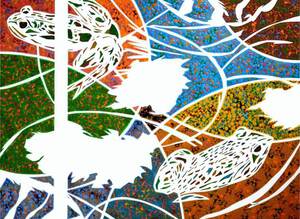
Frog 2022
2022Amphibians are the transition between aquatic and terrestrial animals. Frogs lay their eggs in large lumps of frog-rit in the water. From the egg hatches a tadpole that can only survive in water: it has a long tail and gills to breathe. But in a few weeks time the tadpole changes entirely: its tail gradually disappears and four paws start to grow, the gills are replaced by lungs. The animal has become a real land animal and climbs ashore.
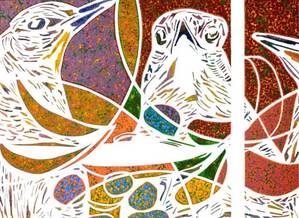
Blackbird
2022In the Serviceberry tree in our garden I spot a female blackbird. Males are predominantly black and have a yellow eye ring and beak. In the breeding season, their melodious singing can be heard in the morning and evening. The female has a yellow-brown or reddish-brown plumage, which looks uniform from a distance, but the underside and the throat are lighter colored and irregularly spotted or striped. The beak and also the eye ring of the female is lighter colored than that of the male and is rather inconspicuous between the brown plumage. Blackbirds have a pointed beak, which is perfectly adapted to consuming seeds. The sharpness makes it possible to pick up small particles, but the length also allows the devouring of larger food. The blackbird is omnivorous and feeds on insects, worms, berries, fruits, snails, waste, bread and bird-food. They usually forage hopping and chopping in the ground. In doing so, they shed moss and leaves, thus aerating the soil. With their big eyes, they search for their prey by tracking the ground and when looking for earthworms, they keep their heads wry, probably to hear soil life. After feeding, they sometimes spit out pellets containing undigested seeds. Consequently the seeds of berries are deposited miles away and so it promotes the distribution of plants, also in the interest of its own species for which food supply is thus ensured.
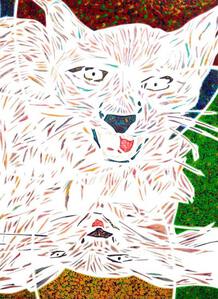
Lynx
2022The Eurasian lynx (Lynx lynx), a feline predator the size of a large dog, is found in Northern and Central Europe. It stands high on its legs, has characteristic whiskers, plumed ears and a short tail with a black tip. In summer the coat is yellow-brown with some small pale specks. Especially the limbs are clearly spotted. Lynxes mainly chase hares, roe deer and chamois. Rodents and fowl such as partridges and grouse are also seized. Lynxes constantly inspect the game-paths in their territory for recent entry by prey. They pounce on sick or weak prey, but especially on inattentive animals. But because on average only 1 in 6 attacks is successful, the prey quickly becomes more cautious and the lynx is forced to move regularly to another part of its territory. In Norway, where limited hunting is allowed, there are about 500 lynxes. In Finland and Sweden, the total population still includes about 2,500 animals. This lynx however, stood stone-still in a Norwegian museum.
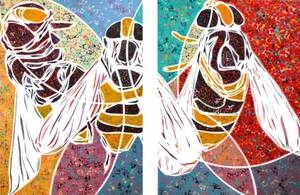
The Hornet Mimic Hoverfly
2022One day in the summer he stopped by. This Hornet Mimic Hoverfly has a yellow abdomen with thin black transverse stripes, a brown-orange shiny thorax and a yellow head. It resembles a bee or bumblebee, but it is a hoverfly. Until recently the insect was rare here, but with the warmer summers it is seen more and more often. It has a preference for an urban environment. The eggs are laid at the bottom of a wasp's nest and the larvae hibernate there when the wasps leave the nest, to pupate the following summer into a new generation of hoverflies. It grows larger (2.5 cm!) than most other species of hoverflies and, like all hoverflies, it lives on nectar and pollen. It cannot sting, but by size and colors resembles the Hornet, one of the most venomous insects. This advantageous resemblance to another species is called mimicry. Other hoverflies look more like small wasps because of their black-yellow stripes or bumblebees because of dense hair, but they all miss the slim ‘wasp-waist’ and fly with skittish movements.
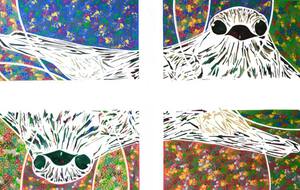
Garden-warbler
2021Shortly after we hung an insect-hotel on our garden wall, we discovered that a garden- warbler had chosen to build a nest of moss and grass on top of it. The garden- warbler is a song-bird of about 14 cm in size (incl. tail feathers), which usually makes a bowl-shaped, well-hidden nest in dense vegetation. It has a rather inconspicuous appearance: a brownish-gray top and a light yellow-brown underside, a round head with a pointed brown beak and gray-brown legs. The food consists of insects, berries and seeds. The garden-warbler breeds from early May to July. One brood per year, with, in our case 4 eggs of which 2 hatched. Breeding time is only 11-12 days. Apparently both parents sit on the eggs, but we didn’t observe that: the male only occasionally brought some food. After hatching, the young were in the nest for 10 days before they flew out, from that moment on we never saw them again. Between July and October, the garden-warbler migrates via France, Spain and Portugal to Africa, where it hibernates south of the Sahara. The crossing to Africa takes place largely via the Strait of Gibraltar.
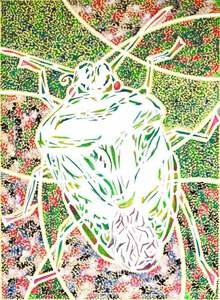
Green Shield Bug
2021The Green Shield Bug is also called the green stink bug. It owes the name stink bug to the foul-smelling substance secreted for defense. The bug is green, only the tips of the wings are brown. Just before hibernation however, the bug turns completely brown, to turn green again in the spring. Males and females locate each other by making vibrations with their body. The vibration is passed on by the plant on which the bug sits, so that other bugs know that a partner is being sought. After mating, the vivid green eggs are deposited on a leaf, from which baby-bugs crawl that already have two antennae and six legs, although the body shape is much more convex. The nymph casts its skin several times and acquires more and more characteristics of the adult animals. The bug feeds on plant juices that are sucked up with the sting-muzzle. As a result, damage is done to crops, which get a typical 'bug smell'. The Hazel is an important food plant. Green shield bugs are common in places where their food plants grow.

Vos
2020During the summer this fox lives on a pass high up in the Alps. A fox is not suitable as a pet. It is usually very shy, although in some circumstances it can learn begging- behavior. And that is clearly the case with this one, which gives me the opportunity to study him at ease. Every day a fox must take about 500 grams of food. Its prey are e.g. mice and other rodents, rabbits, hares, hedgehogs, birds and eggs, but also large beetles and earthworms. It feeds on fruits and berries (especially blackberries) as well as carrion and waste. So the fox is an omnivore, on this spot it scratches up a dinner from the scraps of food left by tourists.
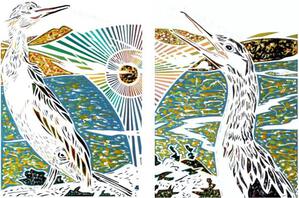
Cormorant
2020The cormorant is 80 to 100 cm long and has a wingspan of 120 to 150 cm. It has webbed feet and catches fish by diving. The beak is long and has a hook-shaped tip. The feather suit seems black, but actually it’s largely deep bronze green. Each feather of the upper wings has a subtle black fringe, which gives the bird a scaled appearance. In the spring, their cheeks and thighs are feathered white, the crown and neck are provided with silvery white mane and the unfeathered throat turns yellow. This gay dress fades away during the breeding season. They are migratory birds: in severe winter weather, cormorants from the Netherlands migrate south to the Mediterranean, while cormorants from the Baltic sea region and northern Germany hibernate here. The cormorant often sits with spread wings on a pole near the water to allow its plumage to dry. Diving birds in general should not have too much buoyancy. To this end, they have heavier bones and smaller air-chambers and they’re able to squeeze air out of their feathers. Cormorants, who dive deep and hunt fish for a long time, go even further. They allow their feather suit to get wet. The barbs on their feathers are relatively far apart, so that the air is pushed out and invading water gets free play. In South-East Asia, tame cormorants are trained to catch fish for their bosses, putting a ring around the bird's neck so it can only swallow very small fish.
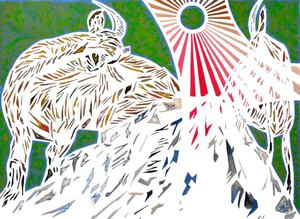
Chamois
2020We are in the National Park Picos de Europa, in the North of Spain. In this gorge live chamois, animals with a goat's appearance and horns that stand straight up, at the end bending backwards like a hook. In 2000 we were here too, and then a chamois caught my attention as well. At the time I made a painting of it, so it could be expected that I would immortalize these chamois too. Chamois are agile climbers, who simply jump from rock to rock. In the wild they may reach an age of 15 to 17 years. Natural enemies are the lynx and the wolf. In summer they eat all kinds of plant food, such as grasses and herbs, buds, needles, bark and twigs. In winter they feed on mosses and lichens.
Pigeon
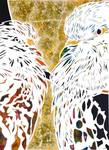
2019Doves (Columbidae) are a family of medium-sized, compact birds with a full, round chest and a small head. They have a fast, undulating flight. The male is called cock-pigeon and the female is called hen or just dove. Unlike other birds, they’re able to suck up water with their beak. The young are fed with so called pigeon’s milk from the crop. A pigeon-fancier is someone who keeps pigeons, but I presume they don’t milk them... A dove broods about 16 to 20 days in a simple, rather messy nest. When the young pigeons are born, they are blind and covered with a thin yellow down. After 3 to 6 days the eyes open and after 11 days they are feathered. The mother stops feeding them after about 16 days, then the young eat themselves. After 25 days they are able to fly.

Chicken
2019We believe that chickens are not blessed with great intelligence, but the 'chicken- language’ is more extensive than most people think. Chickens do produce 30 to 40 different sounds, all of which have a different meaning. They warn each other for instance with an air-raid alarm: when a bird of prey is flying over, they make a kind of squeaking, creaking sound, while in the case of danger on the ground, they will cluck in panic. This communication even takes place while the chickens are still in the egg. A mother hen passes her knowledge to her chickens and they answer with squeaks through the eggshell. Young chickens are nidifugous, which means that after hatching, they are immediately able to walk and search for food, although they will spend the first few days mostly in the soft, warm down of the mother hen. When the mother finds that they are too pig-headed or when they wander off, by the time they get more independent, she will recall them with her clucking. The crowing of a rooster has developed into a regular season-independent cry, which predominantly serves for demarcation of the territory.