
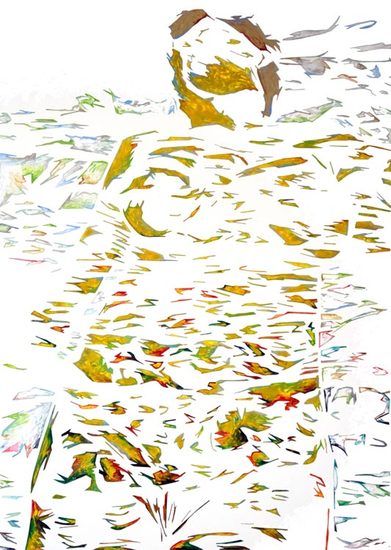
Flood is a phase of the tide when seawater rises and floods upper parts of the coast. The phase of falling water is called ebb-tide. The water-level reached at the end of the period of flood, is called high tide. The time-lag between the beginning of one flood and the beginning of the subsequent flood is an average of 12 hours and 25 minutes. The rise and fall of the tides are due to the influence of the mass of moon and sun. At full moon and new moon the tidal forces become stronger, because the power of attraction from these celestial bodies strengthen eachother, when sun, moon and earth are in a straight line. As a result, the flood comes up faster and reaches a higher level. This phenomenon we call spring-tide. The inundation of Zeeland in de Netherlands in 1953 was caused by a storm surge due to a heavy north-westerly storm, in combination with spring-tide. Near the Mont Saint Michel in Normandy the tide may rise with the speed of a running horse. In this painting the water flows through the veins to the inland.