
The human body
The human body The subject of these paintings is the human body in combination with landscapes.
dated 1998 until 2015
(click on an image to enlarge an artwork)
stuur een bericht

Eye
2015The eye is our gaze outward, the world comes to us through the eye. The simplest eyes, for instance in micro-oranisms, only detect if their surroundings are light or dark. More complex eyes can distinguish shapes and colors. 96% of all animal species possess a complex optical system that collects light from the environment, regulates its intensity by means of a diaphragm, concentrates the image by an adjustable set of lenses, translates this image into a series of electrical signals and sends these signals to the brain. I am always fascinated by the question whether our eyes see the world as it really is.
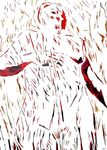
Big Sand Gairloch
2014The retreating tide on the beach of Big Sand Gairloch, leaves its marks in the wet sand. At low tide, the water makes its way back to the sea, to be propelled forward again at high tide, as the veins of the Earth, comparable with blood, driven through the human body by the beating heart.
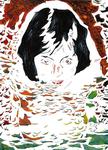
Brionne
2014In the village of Brionne in Normandy is the ruin of this Dungeon, a guard tower from the middle ages. This nearly square dungeon or donjon of 20 m is a typical example of the blind watchtowers from the 11 centurye . Normally such a tower, but this one has a dense wall vertical narrow holes, presumably shooting holes, in the 4 m thick walls.
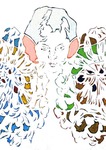
Primrose
2014This primrose is called Primula Bulleyana. It thrives with dark yellow flowers in the period of May-June. The plant was introduced in Great Britain in 1908 by a man called George Forrest. He did this by order of Arthur Kilpin Bullley, director of a plant nursery, after whom the species was named. Initially trained as a pharmacist, Forrest became skilled in drying and preserving plant material and was schooled in their medical qualities. Using a legacy, he traveled to Australia in 1891 in order to explore its nature and trying to make a career as a sheep-farmer and gold-digger, but after ten years he returned to Great Britain and decided to engage seriously in botany and horticulture. In 1903 he was hired as an assistant at the Herbarium of the Royal Botanic Garden in Edinburgh.
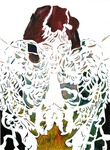
Two ferns
2014The fern belongs to a well-known group of plants (Pteropsida). There are thousands of different types of ferns. They are abundant in rain forests, because moisture is guaranteed in that environment. This specimen sprouts from a rhizome. The leaves rise above the ground curled up, and unroll into elongated leaves under the influence of the light.

Flood
2014Flood is a phase of the tide when seawater rises and floods upper parts of the coast. The phase of falling water is called ebb-tide. The water-level reached at the end of the period of flood, is called high tide. The time-lag between the beginning of one flood and the beginning of the subsequent flood is an average of 12 hours and 25 minutes. The rise and fall of the tides are due to the influence of the mass of moon and sun. At full moon and new moon the tidal forces become stronger, because the power of attraction from these celestial bodies strengthen eachother, when sun, moon and earth are in a straight line. As a result, the flood comes up faster and reaches a higher level. This phenomenon we call spring-tide. The inundation of Zeeland in de Netherlands in 1953 was caused by a storm surge due to a heavy north-westerly storm, in combination with spring-tide. Near the Mont Saint Michel in Normandy the tide may rise with the speed of a running horse. In this painting the water flows through the veins to the inland.

Amaryllis
2013The bulbs we call Amarylllis, actually belong to the genus Hippeastrum, a genus of bulbs from the Narcissus-family, originating from the (sub)tropical regions of Mexico and the Caribbean down to the North of Argentina. The genus includes about 75 species and over 600 hybrids and cultivars. Some species and hybrids are cultivated for their large, showy flowers. The first commercial growers of Hippeastrum were Dutchmen. In the beginning of the eighteenth century they imported various types of bulbs from South America and started cultivating them. The name Amaryllis was derived from a shepherdess appearing in a collection of bucolic stories, the ‘Idylls’ by the ancient Greek writer Theocritus, but actually Amaryllis is the name of another bulbous plant from the same family, originating from Africa. To make it even more complicated, two Dutch growers moved to South Africa in 1946 to grow Hippeastrum there. And up till now most cultivated forms of Hippeastrum come from the Netherlands or South Africa. Generally the Dutch bulbs produce flowers first and develop their leaves afterwards. The South African varieties develop their flower stems and leaves simultaneously.
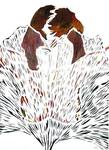
Ginkgo leaf
2013Ginkgo Biloba together with the Ginseng-root originate from the old Chinese pharmacy. Together they have conquered the West as a sort of miracle elixir. But the Ginkgo, the Japanese walnut tree, has an exceptional history that dates back to the era of the dinosaurs. It is a living fossil from the Mesozoic era, of which all other family members were extinct long ago. The name is derived from the Japanese 'ginkyo' which means 'Silver Apricot’. The word 'biloba' means 'two lobes' and refers to the shape of the leaves. The spelling with a 'g' instead of a 'y' is the result of a spelling-mistake that ended up in the official titles.
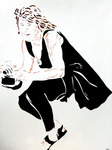
The Photographer
2012It is better not to be distracted, when taking a picture.
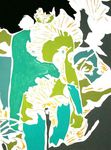
Man in het Kool
1999