
Plants
Plants Flowers and plants, the organic shapes that cover the earth, and provide food and oxygen and assimilate the carbondioxyde. All of these are reasons to emphasise their beauty.
dated 2010 until 2026
(click on an image to enlarge an artwork)
stuur een bericht

Asparagus
2026

Mango
2026

Witloof
2026

IJsbergsla
2026

Brocoli
2026Brocoli

Paprika
2026

Sarracenia
2025Sarracenia
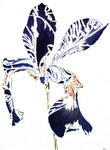
Iris
2010The Iris occurs in almost every colour of the rainbow, except flaming red. The connection of this beautiful flower with the rainbow originates from Greek mythology. The goddess Iris was a messenger between gods and humans. With her golden wings and winged feet she descended from heaven to earth, and was blown along the rainbow by the wind.
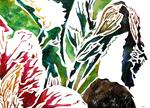
Flower
2012This is a piece of the Beemster, the polder that was created 400 years ago. After the draining of the former lake by order of the merchants of Amsterdam, they subsequently built there their pleasure-grounds here. The rest of the new land was destined for agriculture and cattle-raising, horticulture and orchards. The rectangular shape of the plots, designed behind a desk, gives the Beemster its special lay-out, which was later applied in the city of New York. In our time we see new pleasure-grounds arise, such as the Long House on the Jisperweg in Westbeemster, of which this flower is a small fragment.
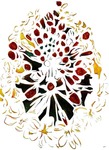
Primrose
2013
In1904-' 06 he undertook an expedition to Southwest China to search for plants suitable to be used as a garden plant in Great Britain. He engaged locals to assist him in collecting them. He gathered roots, tubers, seeds, and dried plants and invested a lot of time in describing his specimens. During this expedition all expedition members were murdered by Tïbetans. Forrest was the only one who managed to escape with help of local people. This probably had to do with the so called ‘British Campaign’ of 1903-' 04, an invasion by the British Indian army, in order to obtain a foothold in Tibet (for fear that Russia would interfere in Tibetan affairs), as was carried out in a similar way in other states around India, for instance in Afghanistan twenty years earlier. This invasion proved to be politically very unpopular at the home front in Britain and the effects on Tibet, except for victims and economic disruption, were minimal and changes did not last long.
At the end of Forrest's expedition many species were included in the collection of the Royal Botanic Garden in Edinburgh. Forrest undertook a total of seven expeditions to China and many plants he brought back were named after him (with the addition: Forrestii). At the end of his seventh expedition, he died of a heart-attack near the upper course of the Mekong, and was buried in the mountains of Yunnan.
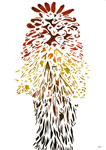
Kniphofia
2012This flower has its origins in the southern and eastern parts of the African continent. There are about 40 to 60 species known. These plants grow mainly at the foot of mountains, preferably in humid conditions, such as along streams and rivers, in rough grassland and stony places. The Kniphofia genus is named after Johannes Hieronymus Kniphof (1704-1763), professor of medicine at the Erfurt University in Germany. Kniphof wrote a number of books such as ‘Botany in Originali’ and ‘Herbaricum Vivum’, in which 1200 illustrations of dried plants were included.
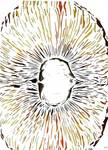
Narcisamaniet
2012The bottom of a Daffodil-amanita. This pale yellow, poisonous mushroom is common in coniferous forests in the dunes of North-Holland and the Wadden Islands. The sheets on the bottom of the cap contain the spores: the germs of a new mushroom. The cap itself protects the spores underneath from rain, in order to prevent them from cleaving together and the stem ensures that they will not fall directly onto the ground below the mushroom, but may be easily dispersed by the wind.

Mushroom
2017There are more than 4000 types of mushrooms in the Netherlands. A mushroom is the aboveground part, the fruit-body, of underground fungi that digest dead remains of plants and animals. Without these fungi, waste would accumulate. Many fungi have no fruit or have such small fruit that it’s not visible to the naked eye, but with mushrooms this is obviously different. Some mushrooms are edible, most famous of course, is the champignon, but most mushrooms are tasteless, have a sharp taste or are downright nasty. Some mushrooms are poisonous. In the Netherlands there are about 30 toxic species, of which 7 are deadly toxic for humans. Some species, that contain psilocybin and psilocin, have a hallucinogenic or psychedelic effect, the so-called ‘magic mushrooms’. In Central- and South America are centuries-old rituals, where Psilocybe Mexicana is eaten to get in touch with the afterlife, the future or a higher reality. Undoubtedly in our regions in the past, mushrooms were also used by medicine-men or –women. According to some authors, experiences with magic mushrooms could underlie religious revelations and visions that were handed down to us. For that reason, mushrooms in the middle ages were regarded as mysterious and diabolical. The mysterious circles in which mushrooms sometimes grow, were called 'witches-circles ', because witches were considered to perform their rituals there.
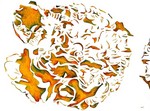
Begonia
2011The family of the Begoniaceae consists of more than a thousand species and is the largest in the vegetable world. Begonias originate from hot, moist jungle areas. Some variaties even climb. The name of this plant family was derived from a former governor of the French colony Haïti, Michel Bégon.

Pine Cone
2011A cone fruit is the woody cone of a pine tree lined with scales, in this case of a spruce. The spruce-fir is distinguishable from the pine-tree by the fact that its needles occur regularly along the shoots, whereas on the pine-tree they grow in tufts. The spruce-fir has flat, triangular or quadrilateral needles and the pine-tree round ones. The green leathery cones that hang from the branches, turn brown in the autumn. Although the seeds have ripened, they can only fall out when the scales of the cone open, which happens the next spring. In the following autumn the cones fall out of the tree.
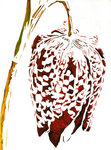
Fritillaria Meleagris
2011The Snake’s Head or Fritilaria Meleagris is a species of the lily family. The flowers have a remarkable chequered pattern. In the Netherlands it’s in the wild a very rare bulb flower and therefore legally protected. The relatively large seeds spread by floating on the water surface. That explains why the plant depends on floods and high water-levels in winter for its dispersion. Not surprisingly that the last wild Snake’s Heads are found along the banks of rivers.
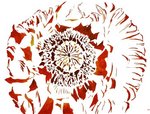
Poppy Flower
2011
Papaver Orientale, the Oriental poppy. The dark brownish-black stamen form a beautiful contrast with the petals of this ‘Beauty of Livermore’, a variety with brightly colored orange-red flowers. The natural range runs from the Caucasus to Iran. This perennial plant can grow up to a meter high. On top of the hairy stem unfolds a ten to fifteen centimeters wide flower.
Rhododendron
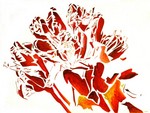
2010Rhododendron (from the Greek ροδον – rhodon - "rose", and δενδρον - dendron - "tree") is a genus of flowering plants in the family Ericaceae. This family consists of more than 1000 species. Among others, heather and - more obvious - azaleas. The rhododendron originates from the Himalaya and mountain areas in China. In Nepal and Sikkim it’s the national flower, as well as in the states of West Virginia and Washington in the United States.
Leander
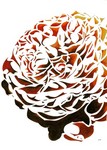
2010Leander Old English rose cultivated by David Austen. Apricot-colored, fading to palish pink with glossy, dark green leaves and very disease resistant. The rose has a lovely raspberry smell. As a climbing rose it rises up to a height of 3.5 metres.